Last Updated: November 2, 2026
Quick Summary
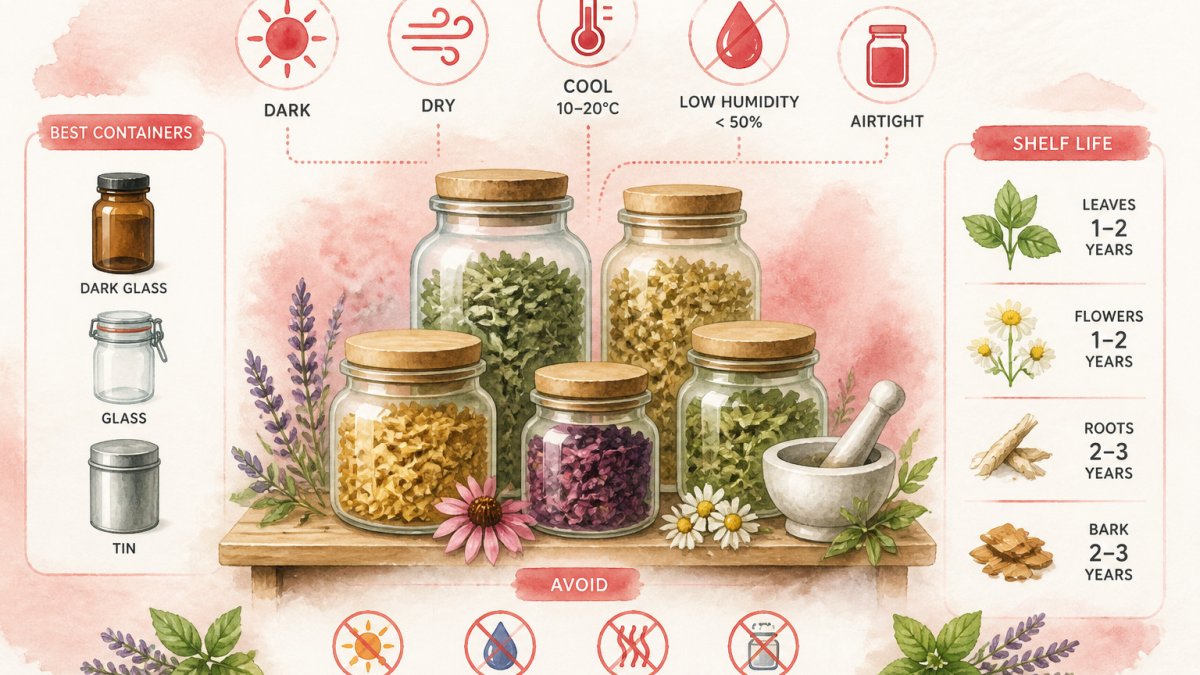
Store dried medicinal herbs in airtight containers, ideally dark glass jars or metal tins, kept in a cool, dark, dry cupboard away from the stove. Light, heat, moisture and air all break down the active compounds that make an herb useful. Keep herbs whole until you need them, since crushed herbs lose potency faster.
- Make sure herbs are fully dry before storing to prevent mold.
- Use dark glass jars or metal tins with tight-sealing lids.
- Keep containers away from the stove, oven and dishwasher.
- Store leaves and flowers about 6-12 months, and roots and bark about 1-2 years.
- Check each jar regularly by smelling, looking at color and feeling for moisture.
Table of Contents
- What Dried Medicinal Herbs Need to Stay Potent
- Preparing Herbs for Storage After Drying
- Best Containers for Storing Dried Herbs
- Storing Herbs Away From Light and Moisture
- Storage Guidance by Plant Part: Leaves, Flowers, Roots and Seeds
- How Long Do Dried Herbs Last in Storage?
- Signs Dried Herbs Have Spoiled and Checks to Run
- Labeling and Restocking Your Herb Supply
- Frequently Asked Questions
What Dried Medicinal Herbs Need to Stay Potent
Dried medicinal herbs lose their strength over time, and the way you store them decides how fast that happens. Light, heat, moisture and air all break down the active compounds that make an herb useful. Good storage protects the plant you paid for.
Storage is about slowing that loss. The goal is to keep the plant dry, cool, dark and sealed from air. Think of it as protection for the herb’s natural oils and compounds, which carry much of its character.
- Keep it dry. Moisture invites mold and can wreck an herb quickly.
- Keep it cool. Heat speeds up the breakdown of active compounds.
- Keep it dark. Light fades color and weakens potency.
- Keep air out. Oxygen slowly oxidizes the plant material.
Each of these four factors matters. Missing just one can shorten the life of an herb that is otherwise well prepared.
Preparing Herbs for Storage After Drying
Before you store anything, make sure the herbs are fully dry. Leaves and flowers should crumble easily, and roots should snap rather than bend. Any leftover moisture will cause trouble later.
A simple check helps. Hold a small handful and look for condensation or soft spots after a day in a sealed bag. If you see moisture, dry the herbs longer.
- Remove stems from leaves and flowers when they are dry.
- Break roots and bark into smaller pieces for even drying.
- Sort out any discolored, moldy or insect-damaged material.
- Keep whole herbs whole until you need them, since crushed herbs lose potency faster.
Watch out: Storing herbs before they are fully dry is one of the most common mistakes. Trapped moisture leads to mold, and mold can make the whole batch unsafe.
Best Containers for Storing Dried Herbs
An airtight container is the most important tool you have. Glass jars with tight-sealing lids and metal tins both work well because they block air and moisture. Dark-colored glass adds extra protection from light.
Choose your container based on how you plan to use the herbs. Here is a quick comparison:
| Container | Blocks Air | Blocks Light | Best For |
|---|---|---|---|
| Dark glass jar, screw-top lid | Yes | Yes | Everyday storage |
| Clear glass jar | Yes | No | Short-term, kept in a dark cupboard |
| Metal tin | Yes | Yes | Herbs you reach for often |
| Plastic bag | Partly | No | Brief holding only |
Plastic bags are the weakest choice. They let in air over time, so use them only for a short hold. Always check that lids seal fully before you close the jar.
Storing Herbs Away From Light and Moisture
Once herbs are in a good container, pick the right spot. A dark cupboard, cabinet or closet away from the stove is ideal. Heat from cooking and appliances can raise the temperature enough to hurt the herbs.
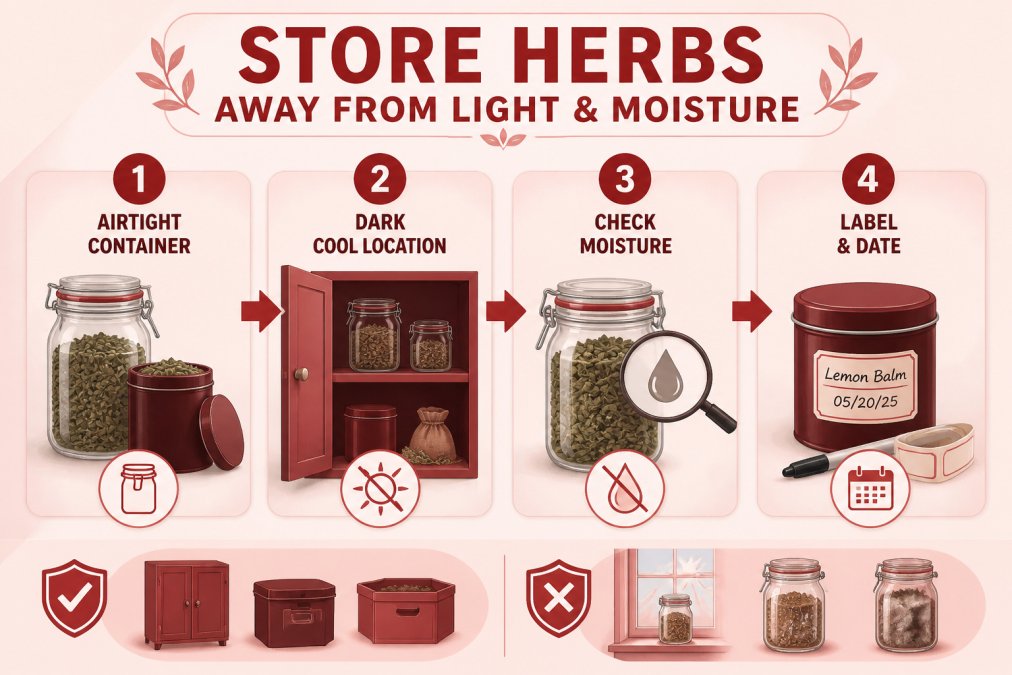
Keep the storage area dry, too. Kitchens and bathrooms often carry humidity, so a cabinet far from the sink or dishwasher is a better choice. A basement can work if it stays dry and cool.
- Store jars in a dark cupboard, not on a sunny windowsill.
- Keep containers away from the stove, oven and dishwasher.
- Avoid the refrigerator for most dried herbs, since condensation can form when you open it.
- Place a food-safe desiccant pack in the jar if humidity is a problem.
Storage Guidance by Plant Part: Leaves, Flowers, Roots and Seeds
A single rule for every dried herb undersells how differently plant parts behave. Leaves and flowers are thin, high in surface area, and rich in volatile oils, so they give up their aroma and active compounds fastest. A plant-by-plant reference on how dried herb parts are identified and handled covers this in more depth. Roots, bark, and seeds are denser and more fibrous, so they hold up longer when kept whole. The practical takeaway: match your container size, your grind timing, and your rotation schedule to the part of the plant you are storing.
| Plant part | Typical useful window (well stored) | Store it | Grind or cut |
|---|---|---|---|
| Leaves (mint, sage, nettle) | About 6-12 months | Whole, airtight, dark | Just before use |
| Flowers (chamomile, calendula, elderflower) | About 6-12 months | Whole and uncrushed; they bruise easily | Just before use |
| Roots (ginger, dandelion, burdock) | About 1-2 years | Whole or in large chunks | As needed |
| Bark (cinnamon, willow) | About 1-2 years | Whole pieces | As needed |
| Seeds (fennel, flax) | About 1-2 years; flax shorter | Whole, sealed | Grind small batches |
How well the herb was dried, how humid your home is, and how often you open the jar all affect how long it keeps its quality. Let your own smell-and-color checks guide you.
- Leaves and flowers: Store whole and in smaller jars you will finish within a season. Crushing them releases volatile oils into the air, so crush only what you are about to use. Delicate flowers like chamomile and elderflower bruise and powder easily, so handle them gently and avoid packing them tight.
- Roots and bark: These are the workhorses of long storage. Keep them whole or in large chunks and break them down as needed. A dense root piece can sit for a year or more and still smell and taste strong if it stayed dry and dark.
- Seeds: The hard outer coat protects the inside, but seeds still need a cool, dark, sealed home. Seeds with high oil content, such as flax, go rancid faster than starchy seeds, so buy them in smaller amounts and smell them before use.
- Any ground or powdered herb: Grinding multiplies the surface exposed to air and light, so potency drops faster. Buy or grind in small batches and use within weeks to a few months rather than a year.
Label each jar with the plant part, not just the herb name. “Ginger root, whole, dried Oct. 2026” tells you far more than “Ginger” when you are deciding what to use first.
Storage slows loss; it does not restore an herb that was weakly dried or already old when you bought it. You can explore a broader multidisciplinary background on healing plants in this desktop reference.
How Long Do Dried Herbs Last in Storage?
There is no single shelf life for dried medicinal herbs, and any guide that gives you one number is oversimplifying. A reference with plant profiles and shelf-life-relevant details can help you learn more about individual herbs. Three things drive how long an herb stays useful: the plant part (see the chart above), how thoroughly it was dried before storage, and how well it is protected from light, heat, moisture, and air. Whole herbs consistently outlast crushed and powdered ones because there is far less surface exposed to oxygen.
A realistic way to think about it:
- Whole herbs: generally outlast crushed and powdered ones, because there is far less surface exposed to air.
- Storage conditions: herbs kept airtight, dark, and cool hold their quality longest.
An herb that has aged is not automatically spoiled, but it may smell dull and look faded. Your senses are a better guide than the calendar.
Do not rely on a fixed date to decide whether an herb is safe. Mold, mustiness, and insect activity are safety issues that a date cannot catch. Always smell and inspect before use, even inside the expected window.
A simple freshness check you can run in under a minute:
- Open the jar and smell it. A strong, true aroma means it is still doing its job; a flat or dusty smell means it has faded.
- Look at the color against what you remember. Heavy fading is a sign of light or age damage.
- Feel for clumping, dampness, or soft spots, which point to moisture.
- Look for webbing, tiny holes, or live insects.
If an herb passes the smell and appearance check, it is fine to use even if it is a little past its window. If it fails on moisture, mold, or insects, discard the whole jar rather than trying to salvage part of it.
Labeling is what makes shelf life manageable. Write the herb name, the plant part, and the date you dried or bought it on every container. Keep a running list of what you have so you can use the oldest stock first. When you restock, put new jars behind old ones. Buying only what you can reasonably use within its window beats a large stockpile that quietly fades in the back of a cupboard.
Signs Dried Herbs Have Spoiled and Checks to Run
Learn to read the signs of spoilage. Discard any herb that shows mold, a musty smell, or insect activity. Those are clear warning signs.
Even without mold, a weakened herb tells you something. Common signs include: a comprehensive herbal reference for judging herb quality and identifying each plant accurately can help you tell them apart.
- Faded color compared to when you first stored it
- A dull or weak smell
- Clumping or dampness inside the jar
- Visible webbing, holes or tiny insects
Run a simple check every few months. Open each jar, smell it, look at the color, and feel for moisture. Replace anything that fails these checks.
Labeling and Restocking Your Herb Supply
Good labeling keeps your herb supply organized and safe. Write the herb name, plant part, and date on every container. Keep a simple list of what you have on hand.
When you restock, rotate your jars. If you are also looking to stock up on other natural wellness products, see our guide to natural alternatives to over-the-counter cold medicine. Place new herbs behind older ones so the older stock gets used first. This habit keeps potency high and reduces waste.
Finally, buy only what you can use within a reasonable time. Smaller, fresher amounts often beat large stockpiles that sit too long. Shop with your storage plan in mind.
Frequently Asked Questions
How long will dried medicinal herbs last?
Most dried medicinal herbs keep their best potency for about one to three years when stored in airtight containers in a cool, dark, dry place. Leaves and flowers tend to fade faster than roots and seeds, which hold their constituents longer. Whole herbs generally outlast crushed or powdered material because less surface area is exposed to air and light. Check each batch for aroma and color, since a weak smell is an early sign that potency has dropped. Label every jar with the harvest or purchase date so you can use the oldest stock first.
What is the best container to store dried herbs in?
Airtight glass jars with tight screw-top lids are among the most reliable choices, because glass does not absorb odors and blocks oxygen well. Dark-colored glass or metal tins protect herbs further from light exposure. Food-grade plastic containers also work if they seal properly, though they can hold odors over time. Avoid paper bags and loose cloth, which let in air and moisture. Choose a container size close to the amount of herb you have so there is less empty air inside.
Should dried herbs be stored whole or crushed?
Store herbs whole whenever possible. Crushing or grinding breaks plant cells and releases volatile oils, which speeds up loss of potency and aroma. Leaves can be kept whole and crumbled just before use. Roots, bark and seeds generally hold up better as whole pieces, and you can grind only the amount you need. If you must store powder, keep it in a small airtight jar and use it within a shorter window than you would for whole herbs.
Where should you keep dried medicinal herbs?
Keep dried medicinal herbs in a dark, cool, dry cupboard, cabinet or closet away from the stove, dishwasher, sunny windows and any humid area. Avoid basements and bathrooms, where moisture can build up. A refrigerator is not a good default, because repeated temperature changes and condensation can introduce moisture when containers are opened. Store containers off the floor and away from direct heat sources to keep conditions stable.
Ready to build a well-stocked natural wellness pantry? Explore the herbs, essential oils and wholesome superfoods at Allstarhealth and start storing your herbs the right way today.