Table of Contents
- Understanding Organic Certification and USDA Standards
- How to Check Organic Food Labels and Certification Seals
- How to Verify Organic Certification Using Official Records
- How to Tell If Produce Is Organic at the Store
- Organic vs Natural Food: Understanding the Key Differences
- Verification Steps You Can Take at Home
- What Laboratory Testing Can and Cannot Prove
- Frequently Asked Questions
Last Updated: October 8, 2026
Understanding Organic Certification and USDA Standards
To verify organic food quality, you need to confirm that a product meets strict federal standards set by the U.S. Department of Agriculture through organic certification.
At Allstarhealth, we help our customers understand what that certification means. USDA organic standards prohibit synthetic pesticides, artificial fertilizers, antibiotics, and GMOs.
Organic certification is a legal designation backed by government oversight and third-party verification, unlike “natural” or “eco-friendly,” which have no legal definition.
The National Organic Program divides certified products into three categories based on organic content:
- 100% Organic: All ingredients are certified organic
- Organic: At least 95% of ingredients are certified organic
- Made with Organic Ingredients: At least 70% of ingredients are certified organic (cannot use the USDA seal)
A product labeled “made with organic” may contain conventional ingredients you want to avoid.
How to Check Organic Food Labels and Certification Seals
The USDA organic seal is your first visual clue, a green-and-white label on certified products that have passed federal requirements.
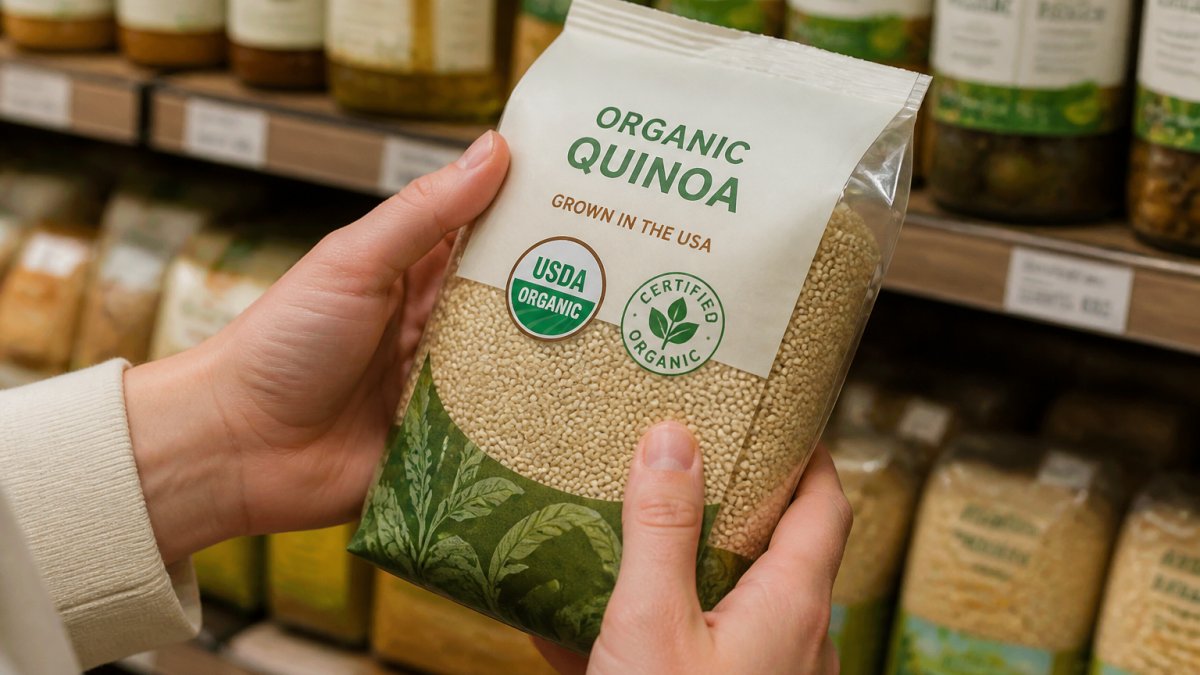
Check the label for the certifying agent’s name, the independent organization that verified compliance, usually printed near the USDA seal.
Look for the producer’s name and address. Legitimate organic products always identify who made them, letting you trace the product to its source.
Read the ingredient list carefully.
Watch for these red flags on the label:
- Missing USDA seal on a product claiming to be organic
- No certifying agent name listed
- Vague sourcing information (“imported from various countries”)
How to Verify Organic Certification Using Official Records
The USDA Organic Integrity Database is your most powerful verification tool, a free, searchable database of every certified organic operation in the U.S., letting you confirm any producer, processor, or handler’s certification status and scope.
Using the USDA Organic Integrity Database
Search by producer name, certifying agent, or location. It shows certification status (certified, suspended, or revoked), certified products, certifying agent, and effective dates. This is where you verify organic food quality claims directly, if a producer isn’t listed, they’re not certified.
The database updates regularly, so you can see if a company lost certification or faced compliance issues. “Suspended” status means they failed an inspection or didn’t renew on time.
Checking Certifying Agent Information
Once you identify the certifying agent from the label, verify its credentials against the National Organic Program’s official list of USDA-accredited agents. Established agents tend to have more rigorous inspection protocols, and some specialize in specific product types, dairy, grains, produce, which often means more thorough inspections.
How to Tell If Produce Is Organic at the Store
At the store, the fastest way to tell whether produce is organic is the combination of the USDA organic seal, the certifying agent’s name, and the producer’s identity. The PLU sticker is a hint, not proof.
What the PLU Code Actually Tells You
Price Look-Up (PLU) codes are four- or five-digit numbers used at checkout to identify produce variety.
Most articles get this wrong: there is no official PLU prefix for genetically modified produce. The often-cited “8” prefix was proposed decades ago but never widely adopted, treat any sticker starting with 8 as an unrecognized code and verify through the label.
A 9-prefix PLU is a helpful signal, not a legal certification. Stickers can be misprinted and bins mislabeled, so use the PLU as a starting point, not a conclusion.
The In-Store Verification Checklist
In the produce aisle, run through these checks in order:
- Look for the USDA organic seal on the bin, clamshell, band, or twist-tie.
- Find the certifying agent’s name. On bulk produce it’s often on the bin tag or twist-tie. If missing, ask.
- Identify the producer. A farm name, region, or distributor should be listed. “Product of multiple countries” is a yellow flag.
- Check the PLU prefix, 9 for organic.
- Ask the produce manager: Who is the certifying agent on this item? and Can you show me the organic certificate for this supplier? Reputable retailers keep these on file.
If a store cannot name the certifier for a product they’re selling as organic, that’s your answer. Walk away or choose a different item.
Why Some Genuinely Organic Produce Has No Seal
The USDA’s National Organic Program includes a retail exemption for small operations. A producer selling less than $5,000 per year in organic products is exempt from certification and cannot use the USDA seal, but may still describe products as organic if they follow NOP rules.
In practice:
- A farmers-market grower with a hand-painted “organic” sign may be legitimately exempt, or using the word loosely.
- Exempt operations aren’t listed in the USDA Organic Integrity Database, so you can’t verify them there.
- Ask the grower directly about fertility, pest handling, and recordkeeping. Exempt producers must still comply with NOP standards.
Produce That Looks “Too Perfect”
The idea that organic produce always looks blemished is a myth. Large organic growers use approved inputs, controlled atmospheres, and modern varieties for uniform fruit, while some conventional produce looks rough. Appearance isn’t a reliable signal, the paperwork is.
When Produce Is Imported
A growing share of organic produce in U.S. stores is imported. Imported organic products must either be certified to USDA standards by a USDA-accredited certifier or come from a country with an equivalency arrangement (U.S.-EU, U.S.-Canada, U.S.-Japan, U.S.-Korea, U.S.-Switzerland, U.S.-Taiwan).
For imported produce, the label should still name a certifying agent. If it names a foreign certifier you don’t recognize, look it up on the USDA’s list of accredited certifying agents.
USDA Organic Integrity Database
USDA list of accredited certifying agents
Organic vs Natural Food: Understanding the Key Differences
“Organic” and “natural” are not the same thing.
Organic is a legal designation backed by USDA certification.
Natural products may still contain synthetic pesticides, artificial additives, or GMOs.
When building a healthy pantry with Allstarhealth’s curated selection, look for organic certification, not just “natural” claims.
The practical difference: an organic apple was grown without synthetic pesticides and verified by inspection.
Verification Steps You Can Take at Home
Below is a five-step workflow you can run in about ten minutes per product using only free public tools, covering domestic and imported products and how to escalate suspected fraud.
Step 1: Capture the Three Identifiers From the Label
Before touching a computer, note three things from the package:
- The certifying agent’s name (e.g., Oregon Tilth, CCOF, Quality Assurance International, Ecocert, OneCert).
- The producer or handler’s legal business name, not just the brand; the two often differ.
- The product category (e.g., “handling” for packaged food, “crops” for produce, “livestock” for meat or dairy).
If any is missing, that’s already a finding, certified products must identify the certifying agent.
Step 2: Search the USDA Organic Integrity Database
The Organic Integrity Database (OID) is the USDA’s official, free, searchable registry of certified organic operations, the most useful verification tool for consumers.
How to search it effectively:
- Go to the OID at USDA Organic Integrity Database.
- Enter the producer’s legal name in the search field. If you get no results, try the brand name, then the certifier’s name combined with the state.
- Open the matching operation record and check four fields:
- Status, should read “Certified.” “Suspended” or “Revoked” means the operation is not currently certified.
- Effective date, should be current, not expired.
- Certifying agent, should match the name on the label.
- Certified products / scope, should include the specific product you bought. A farm certified only for “crops” is not certified to sell you organic yogurt.
If the operation does not appear in the OID, it is not a USDA-certified operation. That does not automatically mean fraud, it may be a small producer operating under the $5,000 retail exemption, but it does mean the USDA seal should not be on the package.
Step 3: Verify the Certifying Agent Is Accredited
A certifier’s name on a label is only meaningful if that certifier is USDA-accredited. Check it against the USDA’s published list of accredited certifying agents.
- Confirm the certifier appears on the current list.
- Note whether their accreditation covers your label’s product scope (crops, handling, livestock, wild crops).
- If the certifier is foreign, confirm they’re USDA-accredited or operating under a recognized equivalency arrangement.
Step 4: Check for Compliance History and Recalls
Certification status is a snapshot; compliance history tells you more.
- FDA Enforcement Report database, search the producer and product for recalls. A recall doesn’t invalidate organic certification but is relevant to quality.
- USDA NOP compliance actions, the National Organic Program publishes proposed suspensions, revocations, and civil penalties. Search the producer and certifier names.
- Certifier websites, many publish their own suspension and revocation notices, often the earliest signal.
A quick web search combining the producer’s name with “organic,” “suspended,” or “NOP” surfaces most public compliance issues.
Step 5: If the Claim Fails Verification, Escalate
If you believe a product is sold as organic without valid certification, you have a clear path:
- Report to the USDA National Organic Program. The NOP accepts complaints about suspected violations, including mislabeled products and fraudulent certificates.
- Report to the FTC for broader deceptive-advertising claims, such as using “organic” language with no certification at all.
- Notify the retailer. Reputable retailers will pull a product while investigating. If they won’t, that’s information about the retailer.
- Notify the certifier named on the label. Certifiers must investigate complaints about operations they certify.
USDA National Organic Program complaint submission
FTC complaint assistant
What This Workflow Cannot Do
Two caveats:
- It verifies certification, not every production claim. The OID confirms an operation is certified and its scope, but not that every batch was produced to standard, that’s what annual inspections and certifier oversight are for.
- It doesn’t cover exempt operations. Producers under the $5,000 threshold aren’t in the OID. For those, verify through a direct conversation with the grower about practices and records.
A ten-minute check, label identifiers, OID lookup, certifier accreditation, compliance history, resolves the vast majority of organic verification questions. When it doesn’t, the NOP complaint process is the correct next step, and it exists precisely for the cases this workflow surfaces.
What Laboratory Testing Can and Cannot Prove
Many consumers assume lab testing can prove whether food is organic. Testing has real limits.
Lab tests can detect pesticide residues, which suggest conventional farming.
Testing cannot prove the absence of pesticides.
Lab tests cannot verify organic system practices, recordkeeping, approved fertilizers, crop rotation.
Testing can identify GMO content through DNA analysis.
Allstarhealth’s approach to organic food quality emphasizes certification records and supply chain verification over lab testing alone.
Verifying organic food quality takes effort, but the process is straightforward once you understand the system. Allstarhealth’s curated selection of organic pantry staples and superfoods helps you elevate your daily nutrition with ease.
Frequently Asked Questions
How can I verify organic food quality before buying it?
Check for the USDA organic label and certification seal on the packaging, then look up the producer or certifying agent in the USDA Organic Integrity Database. Verify the product’s organic content percentage (100% organic, organic, or made with organic ingredients) and confirm the certifying agent is legitimate. For produce, use the PLU code sticker system: codes beginning with 9 indicate organic produce. Cross-reference the producer’s name and location in the official database to confirm active certification status and compliance history.
What’s the difference between organic and natural food?
Organic food is certified by the USDA and meets strict National Organic Program standards covering farming practices, pesticide use, and recordkeeping. Natural food has no legal definition and is not regulated by the USDA, manufacturers can use the term freely. Organic certification requires annual inspections and documentation review; natural claims require no verification. Always look for the USDA organic seal to confirm a product meets actual regulatory standards, not just marketing language.
Can you tell if produce is organic just by looking at it?
No, you cannot reliably identify organic produce by appearance alone. Organic and conventional produce look nearly identical. Instead, check the PLU sticker code: organic produce codes start with 9, conventional codes start with 3 or 4. You can also ask the produce manager for certification documentation or check the store’s records. Some farmers markets display producer names, which you can verify in the USDA Organic Integrity Database for confirmation of active certification.
What does the USDA organic label actually guarantee?
The USDA organic label certifies that a product meets National Organic Program standards: no synthetic pesticides, no artificial fertilizers, no antibiotics or growth hormones (for livestock), and documented organic system plans. It confirms the producer has passed annual farm and processor inspections and maintains supply chain traceability records. However, the label does not guarantee nutritional superiority, taste, or that no pesticide residues are present, organic crops can have low residue levels from environmental sources. Laboratory testing is not required for certification.