Table of Contents
- Start by Auditing What Your Household Actually Eats
- Build Your Pantry Inventory Checklist
- Choose Bulk Pantry Staples That Earn Their Shelf Space
- Master Food Storage and Rotation So Nothing Spoils
- Set Replenishment Thresholds and a Restock Schedule
- Emergency Food Supply Planning for Supply Disruptions
- Budget for a Consistent Food Supply Without Overspending
- Conclusion
- Frequently Asked Questions
Last Updated: October 18, 2026
Start by Auditing What Your Household Actually Eats
Most pantry plans fail because people stock what they think they should eat, not what they actually eat.
Here is how we would run it:
- Keep every grocery receipt for 14 days.
- Note each dinner you cook, including takeout nights.
- Mark which meals repeat most often.
- List the core ingredients behind those repeats.
You will usually find five to eight meals doing most of the work. Those define your true food needs.
The audit also exposes waste: half-used specialty flour and forgotten cans are money already spent. Cutting them frees budget for staples you will use.
Check your bin and fridge before you shop, not after. The items you throw away most often are the ones to stop buying in bulk.
Build Your Pantry Inventory Checklist
A pantry inventory checklist lists every staple you keep, the amount on hand, and your baseline target. It turns guesswork into a repeatable system.
Start with categories rather than brands:
- Grain base: rice, oats, pasta, flour, cornmeal
- Protein: beans, lentils, canned fish, nuts, seeds
- Fats and oils: olive oil, coconut oil, ghee
For each line, record three numbers: current count, target count, and a reorder point.
Keep the list where you store food or on your phone, and update it when you cook.
Choose Bulk Pantry Staples That Earn Their Shelf Space
Bulk buying saves money only when the food gets eaten.
Our rule: buy bulk only for items you use weekly. Everything else stays in small amounts.
Good candidates for bulk pantry staples:
- White rice and rolled oats
- Dried beans and lentils
- Pasta and flour
Weaker candidates: specialty flours, niche grains, and impulse buys driven by price per kilo.
Buy organic staples in bulk only when the item is a daily driver; for occasional ingredients, small packs keep the pantry fresher and the budget cleaner.
Master Food Storage and Rotation So Nothing Spoils
Food storage and rotation means keeping staples in conditions that slow spoilage and using the oldest stock first. Get this right and your pantry stops being a place where food quietly dies.
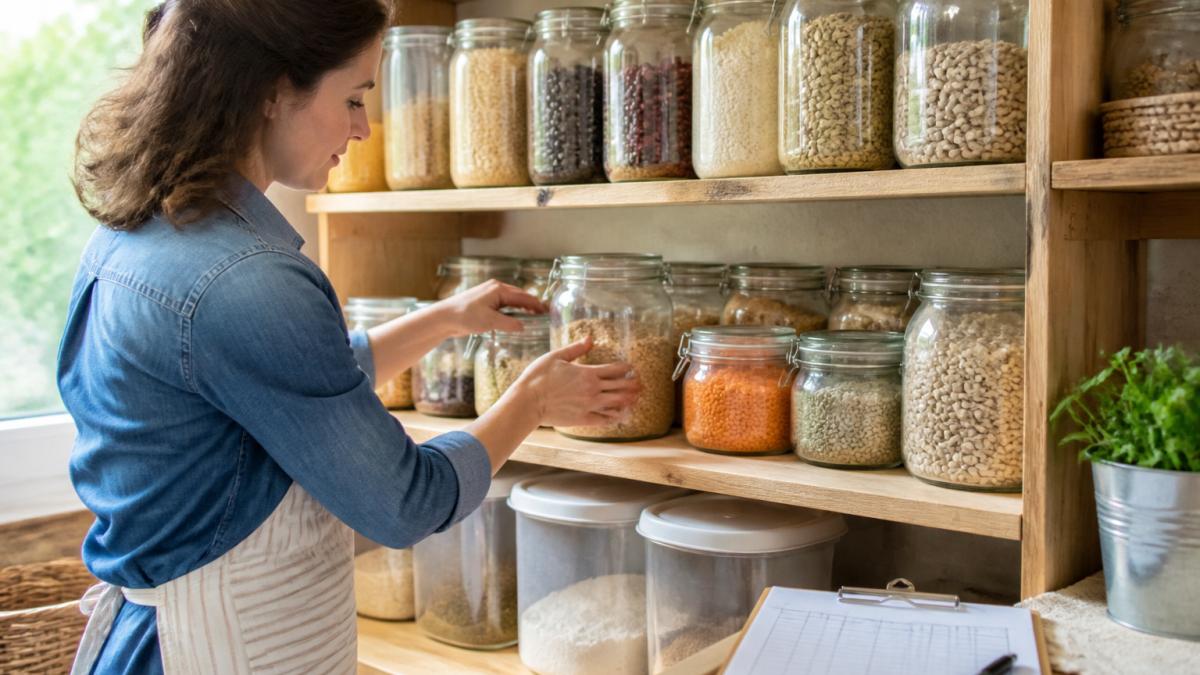
The core rules:
- Keep dry goods in airtight containers, away from heat and light.
- Label every container with the food name and the date you filled it.
- Store new stock behind old stock, never in front.
Repackaging matters more than most guides admit. An open paper bag of flour invites moisture and pests; sealing it in a jar the day it arrives protects the whole batch.
Never store dry goods directly against a concrete floor or an outside wall. Moisture wicks through and spoils the bottom of the bag first, often without any visible sign until you open it.
Clean storage matters too: wipe shelves, keep cleaning compounds away from food containers, and never store sanitizing agents beside open food.
Set Replenishment Thresholds and a Restock Schedule
This is the step most pantry guides skip, and it keeps a consistent food supply running. A threshold is the stock level that triggers a reorder; a schedule is when you check it. Together they turn a static pantry into a system that refills itself before you run out.
How to calculate a reorder point
A reorder point is not a guess. It covers normal consumption during the lead time, a safety buffer for delays, and any minimum order size. A simple formula:
Reorder point = (weekly usage × lead time in weeks) + safety buffer
If your household uses 1 kg of rice per week and your store reliably restocks within two weeks, you need 2 kg just to cover the wait.
Lead time matters more than most people realize. A bulk online order may take 5-10 days; a local restock may be same-day but unreliable during a disruption. Use the longer of the two when setting the threshold.
A worked threshold table
| Staple | Baseline Stock | Weekly Usage | Lead Time | Safety Buffer | Reorder Point | Check Frequency |
|---|---|---|---|---|---|---|
| Rice | 10 kg | 1 kg | 2 weeks | 1 week | 3 kg | Monthly |
| Dried beans | 6 kg | 0.5 kg | 2 weeks | 1 week | 1.5 kg | Monthly |
| Olive oil | 4 bottles | 0.25 bottle | 3 weeks | 1 week | 1 bottle | Monthly |
| Canned tomatoes | 24 cans | 3 cans | 1 week | 1 week | 6 cans | Every 2 weeks |
| Oats | 5 kg | 0.75 kg | 2 weeks | 1 week | 2.25 kg | Monthly |
The logic is straightforward: when stock drops to the reorder point, it goes on the next order. You never run out and never overbuy, and the safety buffer absorbs the week the store is out or the delivery is late.
Run a fixed review cadence
Pair the thresholds with a fixed review day, the first weekend of the month works well, with a quick mid-month check on fast movers like canned goods and cooking oil. Fifteen minutes with the checklist keeps the system honest.
A practical review routine:
- Walk the pantry with the checklist and count only items at or near their reorder point.
- Note the date and the current count for each.
- Add anything at or below threshold to the next shopping list.
- Check the calendar for upcoming bulk orders and consolidate to save on shipping.
- Update the checklist the same day, not later.
Set a phone reminder for the review day and keep the checklist in the same place every time. The system fails when the list lives in three different spots.
Handle lead times and supply wobbles
A replenishment system also smooths out supply chain wobbles. When a store is out of your usual rice, you already have weeks of cover at home. Two habits make this work:
- Order early, not at the threshold, for long-lead items. If a bulk order takes two weeks, place it when stock hits the reorder point plus one week of usage.
- Keep a backup source. Know a second store or supplier for your top five staples so a single outage does not stall the system.
Track whether the system is actually working
A replenishment schedule is only useful if you can tell whether it is holding. Two measures are enough:
- Stockout frequency: how many times per month a staple hits zero before the next order arrives. More than once a month means the reorder point is too low or the lead time estimate is wrong.
- Days of supply: current stock divided by daily usage, for your top staples. If rice is at 12 days of supply and your lead time is 14 days, you are already behind.
Review both numbers at each monthly check. If stockouts keep hitting the same item, raise its reorder point rather than blaming the store, the system should absorb the wobble, not react to it.
A note on budget and bulk
Replenishment thresholds also protect the budget: buying at the reorder point means buying what you will use, in the quantity you will use, at a predictable pace, cheaper than panic buying and cheaper than letting stock expire. If a bulk discount tempts you above your baseline, check whether the extra will be eaten before it spoils; if not, the discount is a cost, not a saving.
Emergency Food Supply Planning for Supply Disruptions
Emergency food supply planning means holding enough shelf-stable food to cover your household through a short disruption, usually two weeks. It is not a bunker project but a buffer, and it only works if built around the disruptions you are likely to face.
Start with scenarios, not a shopping list
Most guides say stock two weeks of food and stop there. A stronger approach names the disruptions you are planning for, because each stresses a different part of your supply. Common scenarios:
- Short store outage (1-3 days): a storm, a local supply issue, or a sudden closure. Your normal pantry usually covers this if it is stocked.
- Transport interruption (1-2 weeks): roads closed, deliveries delayed, or a regional shortage. This is where a two-week buffer earns its place.
- Power outage (hours to several days): the fridge and freezer stop working, so shelf-stable food and a power-independent cooking method become the priority.
Write down the two or three scenarios most likely for your location, coastal storm, winter ice, wildfire smoke, or a rural delivery gap, and build the buffer around those first.
Cover the dependencies, not just the food
A food reserve is unusable without the things that make it edible. Cover these alongside the food:
- Water: stored drinking water plus a way to treat more. A common planning figure is one gallon per person per day for drinking and basic hygiene, so a two-week buffer for four people is roughly 56 gallons. Store what you can and keep a treatment method, filter, purification tablets, or a boil plan, for the rest.
- Cooking fuel: spare canisters or a backup stove that suits your home. Check that the fuel type is safe for indoor use, or plan to cook outdoors.
- Equipment: a manual can opener, a working thermometer, spare batteries, and a way to light a fire or stove.
Build the buffer from food you already eat
Build the buffer from food you already eat, rotating it into normal meals and replacing what you use. Nothing expires and nothing tastes unfamiliar in a stressful week, the buffer should look like a slightly larger version of your normal pantry, not a separate stash.
Put dietary needs in the plan
Dietary needs belong in this plan too. If someone in the house has an allergy, a medical diet, or cultural food requirements, the emergency stock must reflect that, a reserve nobody can safely eat is not a reserve. Check labels for allergens before buying in bulk, and keep a separate shelf for medical-diet items so they are not rotated into general meals.
Test the plan before you need it
A plan you have never tested is a guess. Run a short trial once or twice a year:
- Pick a weekend and cook only from the emergency buffer.
- Note what you reached for, what ran out, and what you could not prepare.
- Check that the can opener, stove, and water treatment actually work.
- Replace what you used and fix the gaps you found.
A trial run exposes the real weak points, a missing can opener, a stove needing unstored fuel, or a child who will not eat the emergency food, while the stakes are low.
Plan the recovery, not just the response
Recovery matters as much as the initial response. After a disruption, restock in this order:
- Perishables first: replace what spoiled in the fridge and freezer.
- Fast movers next: the staples your household uses weekly.
- Buffer last: top the emergency reserve back up to its baseline over the following weeks.
Update the checklist and note what the disruption taught you. If a scenario revealed a gap, fix it before the next season.
The best emergency food supply is the one you already cook with, tested once a year and restocked in a clear order. Familiar shelf-stable foods rotate naturally and cause no disruption when you need them.
Budget for a Consistent Food Supply Without Overspending
A consistent food supply is cheaper than an emergency scramble.
Cost per serving is the number that matters.
Ways to keep the budget in check:
- Build the pantry gradually, one category per month.
- Buy bulk only for weekly staples.
- Track spoilage and cut the repeat offenders.
At Allstarhealth, we stock natural and organic pantry staples and superfoods for households building exactly this kind of supply.
That gradual approach also spreads the cost. Most households can build a two-week buffer over a few months without a single large outlay.
Conclusion
The hard part of pantry planning is not storage or shopping. It is consistency, and consistency comes from a system you actually maintain: an audit, a checklist, reorder points, and a rotation habit.
Allstarhealth can supply the staples that system runs on. Our curated range of natural and organic grains, beans, and superfoods, plus wellness resources like herbal medicine and essential oils, is built for households that want a nutritious, natural food supply.
Frequently Asked Questions
How do you maintain a consistent food supply at home?
Maintain a consistent food supply by auditing what your household eats, keeping a pantry inventory checklist, and restocking when items hit a set threshold. Store shelf-stable staples in airtight containers, rotate older items to the front, and review stock levels monthly. Aim for a two-week buffer of meals you actually cook, then extend gradually. This keeps your pantry working as a living system rather than a one-time stockpile.
How much food should you keep on hand for emergencies?
A practical starting point is a two-week supply of meals your household already eats, then build toward one to three months as storage and budget allow. Count water, cooking fuel, and any equipment dependencies too. Emergency food supply planning works best when it mirrors your normal diet, so include rice, beans, canned foods, and dry goods you rotate regularly rather than buying special items you never touch.
How do you rotate pantry food to prevent waste?
Use first in, first out: place new purchases behind older ones and pull the oldest items forward. Label containers with purchase or best-by dates, check expiration dates monthly, and plan meals around items nearing their limit. A simple food storage and rotation routine, paired with your pantry inventory checklist, keeps freshness high and food waste low while ensuring nothing sits forgotten at the back of the shelf.
How often should you check and replenish your pantry?
Do a quick visual check weekly and a full inventory review monthly. During the monthly count, note stock levels against your thresholds and restock anything below them. Replenishment works best on a schedule tied to your shopping rhythm, whether that is a weekly grocery run or a monthly bulk order. Adjust thresholds seasonally, since household needs and storage space change throughout the year.