Last Updated: November 1, 2026
Quick Summary
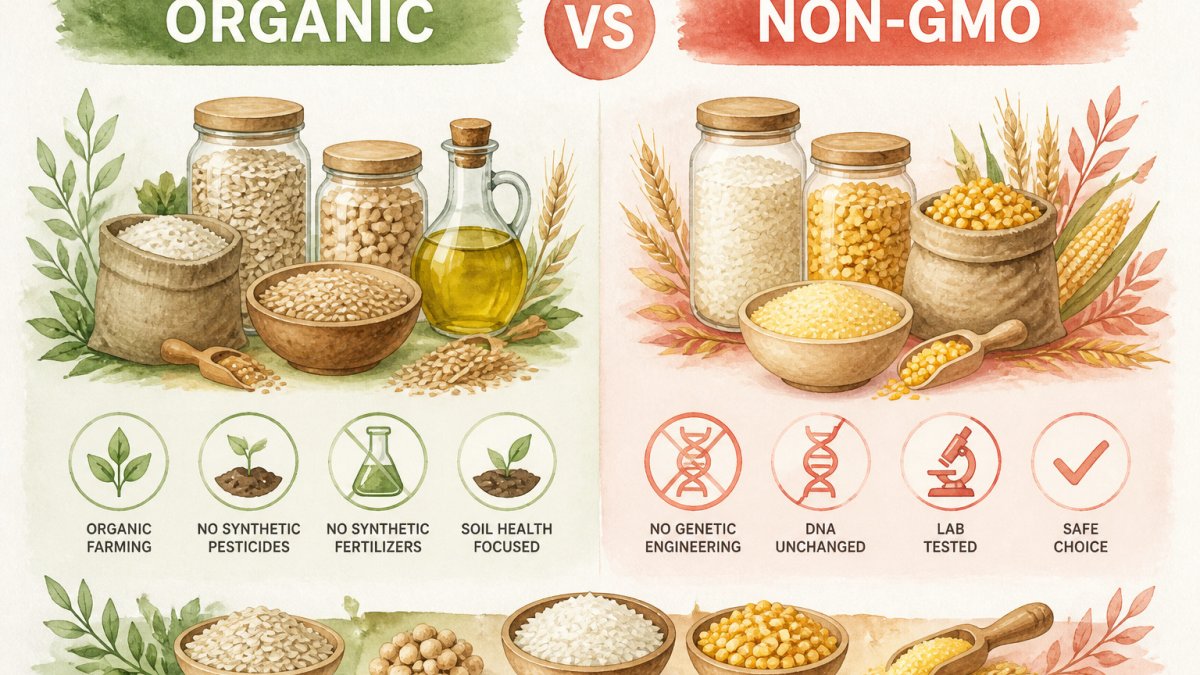
Organic and non-GMO are different claims. Organic certification covers how a food is grown, handled and processed, while non-GMO means no genetically engineered ingredients were used. A product can carry one, both, or neither, so the organic vs non-GMO labels answer different questions.
- USDA organic certification covers growing, handling and processing methods, and it must be certified by an accredited agent.
- The Non-GMO Project Verified seal tests major high-risk ingredients such as corn, soy and canola.
- A non-GMO claim does not tell you whether synthetic pesticides were used on the crop.
- Organic rules prohibit genetic engineering, but a product with an organic seal may contain non-organic ingredients not verified as non-GMO.
- Read the tier wording, such as “100% organic” or “made with organic,” to see how much of a product is actually organic.
Table of Contents
- What Organic and Non-GMO Labels Actually Mean
- What Does Non-GMO Mean on a Pantry Label?
- USDA Organic vs Non-GMO: Side-by-Side Comparison
- Can a Product Be Both Organic and Non-GMO?
- Which Pantry Staples Are Non-GMO but Not Organic, and the Reverse
- Which Organic Pantry Staples Are Worth Prioritizing
- Reading Pantry Labels and Planning Your Next Shopping List
- Frequently Asked Questions
Organic and non-GMO labels appear on the same pantry shelves, and many shoppers assume the phrase organic vs non-GMO describes one idea, but they do not mean the same thing. They do not. Organic certification covers how a food is grown, handled and processed, while non-GMO claims focus on whether genetic engineering was used. Knowing that difference helps you choose oats, rice, oils and sweeteners with confidence. This guide explains what each label guarantees, where the two overlap, and how to read a pantry label before you buy.
What Organic and Non-GMO Labels Actually Mean
Organic describes a production and handling system. A USDA organic product must meet federal standards covering farming practices, approved inputs and handling, and it must be certified. Non-GMO describes one question only: whether the ingredients were produced through genetic engineering.
Because the two claims answer different questions, a product can carry one, both, or neither. A bag of oats labeled non-GMO may still be grown with conventional pesticides. An organic product, by contrast, is generally expected to be non-GMO in its organic ingredients, though the label alone does not prove every ingredient was tested.
What Does Non-GMO Mean on a Pantry Label?
A non-GMO claim means the product was made without genetically modified organisms, which are plants, animals or microorganisms whose genetic material was altered through engineering techniques. The Non-GMO Project Verified seal is one of the most visible third-party marks in the United States. According to the Non-GMO Project, its verification includes testing of major, high-risk ingredients, such as corn, soy and canola, rather than testing every item in a recipe.
That distinction matters for pantry staples. A non-GMO label does not tell you whether synthetic pesticides were used on the crop. It only speaks to genetic engineering.
USDA Organic vs Non-GMO: Side-by-Side Comparison
The two labels differ in scope, testing, and what ingredients they cover. The table below summarizes the key differences for everyday pantry shopping.
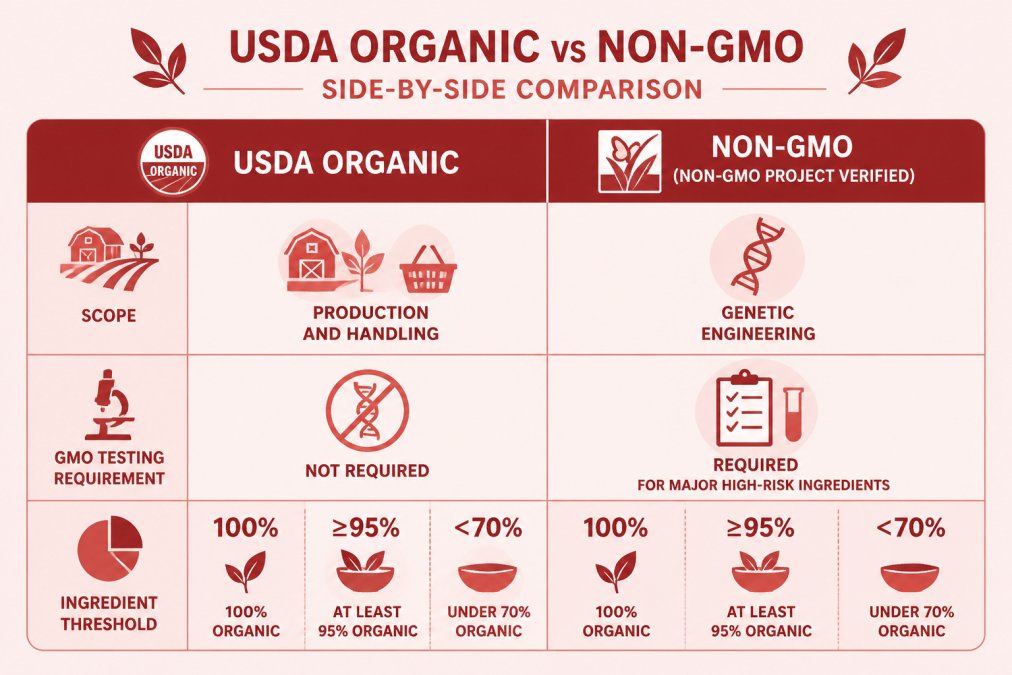
| Feature | USDA Organic | Non-GMO (Project Verified) |
|---|---|---|
| What it covers | Growing, handling, and processing methods across the certified operation | Absence of genetically engineered ingredients in the verified product |
| Pesticides and synthetic inputs | Restricted under organic rules; allowed substances appear on the National List | Not addressed by the claim |
| GMO testing required | Not required by organic certification itself | Required for major high-risk ingredients (e.g., corn, soy, canola, sugar beet) |
| Ingredient threshold | 100% organic, at least 95% organic, or under 70% organic with specific label wording | Applies to the verified product and its high-risk inputs |
| Verification body | USDA-accredited certifying agents | Non-GMO Project and its approved verification partners |
| Best for | Shoppers prioritizing farming and handling practices | Shoppers avoiding genetic engineering specifically |
What the organic label actually requires. USDA organic certification is a production and handling standard, not a testing program for genetic engineering. A certified operation must submit an organic system plan, keep records, and be inspected by an accredited certifying agent. The standard restricts synthetic pesticides and fertilizers, prohibits genetic engineering in organic production, and sets rules for processing, packaging, and labeling.
What the Non-GMO Project Verified seal actually requires. The Non-GMO Project is a third-party verification program. Its standard requires testing of major high-risk ingredients and supply-chain documentation, but it does not test every ingredient in a multi-ingredient recipe. That is why a non-GMO claim can appear on a product that still contains conventionally grown ingredients. The claim speaks to genetic engineering only; it says nothing about pesticide use, animal welfare, or farming methods.
When comparing two pantry items, read the label tiers first: “100% organic” is the strictest organic claim, while “made with organic” allows a larger share of non-organic ingredients. On the non-GMO side, look for the Non-GMO Project Verified seal rather than a plain “non-GMO” text claim, which is not a third-party certification.
Where the labels overlap and where they diverge. Organic rules prohibit genetic engineering in organic production, so the organic portion of a certified product should be non-GMO. However, a product with an organic seal may contain a small share of non-organic ingredients (depending on its tier), and those ingredients are not automatically verified as non-GMO. Conversely, a Non-GMO Project Verified product may be grown with conventional pesticides and synthetic fertilizers. Neither label guarantees a particular health outcome, and neither is a substitute for reading the ingredient list.
A note on label claims that are not certifications. Terms like “natural,” “clean,” “non-GMO” without a seal, and “made with organic ingredients” are not equivalent to third-party verification. The USDA organic seal and the Non-GMO Project Verified seal are the two marks most shoppers can rely on for third-party oversight.
Can a Product Be Both Organic and Non-GMO?
Yes, and many products are. Organic rules prohibit the use of genetically engineered ingredients, so an item labeled “100% organic” should contain no GMOs. For products labeled “organic,” the organic portion of the ingredients follows the same restriction.
Still, the overlap is not guaranteed for every item in every package. A product with an organic seal may have a few ingredients outside the organic standard, and those ingredients are not automatically verified as non-GMO. If avoiding genetic engineering matters to you, look for both labels, or check the ingredient list for the specific crops that carry the highest GMO risk.
Which Pantry Staples Are Non-GMO but Not Organic, and the Reverse
Most label guides talk about food broadly. Pantry staples are where the organic vs. non-GMO distinction gets practical, because the two labels show up on different products for different reasons.
Grains and flours. Oats, rice, wheat flour, and cornmeal are common pantry staples where the labels diverge. Non-GMO Project Verified oats and rice are available from some brands that test high-risk inputs but do not certify organic.
Beans and legumes. Dried beans, lentils, and chickpeas are rarely genetically engineered as crops, so the non-GMO label adds less new information than it does for corn or soy.
Oils. Canola, soybean, and corn oils are high-risk GMO crops, so the non-GMO seal is meaningful on those bottles. Organic oils carry the organic seal and exclude genetic engineering from the certified ingredients.
Canned goods and packaged foods. Canned tomatoes, soups, and packaged mixes are multi-ingredient products, which is where label reading gets tricky.
Sweeteners. Sugar, honey, and maple syrup illustrate the distinction well. Non-GMO sugar may come from conventional sugar beets or cane that has been verified for genetic engineering status, while organic sugar must meet organic production rules.
Spices and seasonings. Spices are often blended and sourced from many suppliers, which makes third-party verification harder. A non-GMO seal on a spice blend signals testing of high-risk ingredients, while an organic seal signals organic production for the organic portion.
The pattern to remember: non-GMO is most informative on high-risk crops (corn, soy, canola, sugar beet), while organic adds requirements across the whole production and handling system. On low-risk crops like beans and honey, the non-GMO label adds less new information than organic does.
Unlabeled staples are not automatically GMO-containing. Many conventional products simply have not been verified. Where a high-risk crop like corn, soy, or canola is an ingredient, the odds of genetic engineering are higher, so the label becomes more useful. Where the crop is low-risk, the absence of a label tells you less.
A practical sorting method. Before your next shopping trip, sort your pantry list into three groups: items where you want organic (high-exposure staples and high-pesticide crops), items where non-GMO is enough (high-risk GMO crops where you mainly want to avoid genetic engineering), and items where either label is fine (low-risk crops like beans and honey). This keeps the decision simple and helps you avoid paying for a label that does not add requirements for that particular product.
Which Organic Pantry Staples Are Worth Prioritizing
Budget matters, so it helps to focus organic purchases where they make the most difference. Shoppers often prioritize items that are high-exposure, meaning eaten daily or in large amounts, and items where the conventional crop is commonly treated with pesticides. Leafy greens, oats, dried beans and cooking oils often appear on these lists, though the choice depends on your household.
Organic is not always the only option that counts. For shelf-stable items like dried spices, sugar or canned tomatoes, you may decide that a non-GMO label is enough. The cost difference can be significant, and it often pays to compare prices across brands before deciding that organic is worth the premium for every item. Pricing depends on product, size, and retailer, so check current prices where you shop.
Reading Pantry Labels and Planning Your Next Shopping List
Reading the label is the fastest way to tell what you are buying. Look for the USDA organic seal, which signals certification, and the Non-GMO Project Verified seal, which signals third-party testing for major ingredients. Read the ingredient list too. A product that says “made with organic oats” is different from one labeled “100% organic.”
Before your next order, sort your pantry into three groups: items you want organic, items where non-GMO is enough, and items where either label is fine. This keeps the decision simple. When you are ready to stock up, check current prices and product details on the Allstarhealth website before you order.
Choosing between organic and non-GMO comes down to what you want each label to guarantee. For more on which staples to stock first, see essential pantry staples for holistic health. Once you know that, the shelf stops being confusing and starts working for your household.
Frequently Asked Questions
How is organic food different from regular food?
Organic food is produced and handled under standards that restrict synthetic pesticides, herbicides, and certain other inputs, and that govern how crops are farmed and processed. Under USDA rules, products labeled 100% organic must contain only organic ingredients, while products labeled organic must contain at least 95% organic ingredients. Organic certification focuses on production and handling methods rather than on the presence or absence of genetic engineering. Conventional food is not subject to these production rules, so it may use synthetic inputs that organic standards prohibit.
Is USDA Organic the same as Non-GMO?
No. USDA Organic certification covers farming practices, restricted substances, and handling, and it states that organic products cannot contain GMOs. A Non-GMO label, such as the Non-GMO Project Verified seal, focuses specifically on avoiding genetically modified ingredients and requires testing of major, high-risk ingredients according to that organization. A product can carry one label, both, or neither, so check the package rather than assuming the two are interchangeable.
Can a product be both organic and non-GMO?
Yes. Many pantry items carry both an organic certification and a non-GMO verification. Because organic products cannot contain GMOs, the organic label already signals non-GMO status for those items. A non-GMO-only product, however, may still use conventionally grown ingredients with synthetic pesticides, so it will not carry organic status. Look for both labels on the package if you want both assurances.
What does the Non-GMO label mean on pantry items?
A Non-GMO label indicates that the product has been verified to avoid genetically modified ingredients. The Non-GMO Project Verified seal, for example, requires testing for major, high-risk ingredients, such as corn, soy, and canola, and their derivatives. The label does not address pesticide use, farming methods, or nutrition, so it answers a narrower question than the organic certification does. Read the full package and any certifying body’s scope before assuming other claims apply.
Which pantry items should I prioritize buying organic?
Start with ingredients where your budget or priorities call for it, such as the staples you use most often. Organic certification matters most where conventional crops are commonly grown with synthetic pesticides or herbicides, so many shoppers prioritize those. Non-GMO verification matters most for crops with widespread genetically engineered varieties, so check which staples you buy are affected. Because organic items often cost more, a practical approach is to pick a short list of high-use staples rather than switching the whole pantry at once.