Table of Contents
- What Are Ancient Grains and How Do They Differ From Modern Grains?
- The List of Ancient Grains You Are Most Likely to Find
- Can Ancient Grains Help With Inflammation? What the Evidence Shows
- Which Grains Are Anti Inflammatory? A Grain-by-Grain Comparison
- Do Whole Grains Cause Inflammation, and What About Arthritis?
- The Benefits of Ancient Grains Beyond Inflammation
- Adding Ancient Grains to Your Meals Without Overcomplicating Them
- Frequently Asked Questions
Last Updated: November 15, 2026
What Are Ancient Grains and How Do They Differ From Modern Grains?
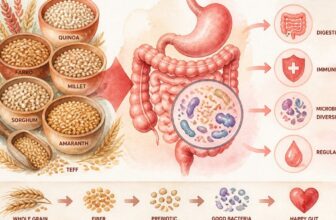
Ancient grains are cereals and pseudo-cereals that have changed little over centuries of cultivation. Varieties such as einkorn, emmer, spelt, farro, teff, quinoa and amaranth remain close to their original forms, while most modern wheat and rice have been bred for yield, uniform size and fast processing. Many people encounter them first as a pantry curiosity, yet they connect to a long record of grain use in the Mediterranean, the Near East and the Andes.

The practical difference lies in the kernel. Modern refined grains strip away the bran and germ, leaving mainly starch. Ancient grains are usually eaten whole, which keeps fiber, minerals and plant compounds in place. That is why the whole-grain versus refined-grain distinction matters more than the ancient-versus-modern label itself.
The List of Ancient Grains You Are Most Likely to Find
Most shoppers meet a short list of ancient grains: einkorn, emmer, spelt, farro, kamut, teff, sorghum, millet, freekeh, barley and quinoa. Quinoa and amaranth are technically pseudo-cereals because they are seeds rather than true grasses, but they are cooked and eaten like grains.
We recommend starting with two or three that suit your cooking. Farro and barley work well in soups and salads, sorghum and millet make good porridges, and einkorn flour behaves differently in baking, so expect a dough that needs gentler handling.
Can Ancient Grains Help With Inflammation? What the Evidence Shows
Inflammation is part of normal immune defense, but long-term low-grade inflammation is linked to chronic disease. Diet is one of the factors researchers study, and many people ask whether can ancient grains help with inflammation in a meaningful way. For a closer look at how these grains affect the gut beyond inflammation, read how to eat ancient grains for better gut health. The evidence is promising in parts and thin in others.
Much of the supporting data comes from laboratory and animal work, which shows that the fiber and plant compounds in whole grains can influence inflammatory markers under controlled conditions. Human trials are fewer and smaller, and results vary by grain, dose and the person eating it. No single grain should be described as treating inflammation.
What lab and cell studies can and cannot tell you
Cell and animal studies are useful for identifying mechanisms, such as how phenolic acids and flavonoids may affect signaling pathways. They cannot confirm what happens in a person eating a normal diet. A compound that reduces inflammation in a petri dish may be absorbed poorly, broken down during digestion or simply present in small amounts in a cooked serving.
What human studies measure, such as inflammation biomarkers
Human studies usually track biomarkers such as C-reactive protein and other inflammatory indicators before and after a dietary change. These measurements are more meaningful than general claims because they show measurable change. Their limits are sample size, short duration and the difficulty of isolating one food from the rest of a diet.
Which Grains Are Anti Inflammatory? A Grain-by-Grain Comparison
Treating “ancient grains” as one food hides the fact that they differ substantially in fiber type, protein, minerals and polyphenol content, and those differences are what shape any plausible effect on inflammation. The table below compares the grains most commonly sold as ancient or heritage whole grains, using commonly published nutrient values per cooked cup. Figures are approximate and vary by variety, growing conditions and cooking method.
| Grain | Fiber per cooked cup (approx.) | Standout compounds | Human evidence relevant to inflammation | Practical serving |
|---|---|---|---|---|
| Barley (hulled or pearled) | 6 g | Beta-glucan (soluble fiber) | Moderate, beta-glucan has been studied in human trials for cholesterol and glycemic response; inflammation-specific trials are fewer | ½-1 cup in soup or as a pilaf |
| Oats (whole groats or steel-cut) | 4 g | Beta-glucan, avenanthramides | Moderate, the most studied whole grain for cardiovascular markers | ½-1 cup cooked |
| Quinoa | 5 g | Saponins, flavonoids, complete protein | Limited, small human trials, mostly on metabolic markers | ½-1 cup |
| Sorghum | 3-4 g | Tannins, phenolic acids | Limited, mostly laboratory and animal data | ½-1 cup as porridge or in salads |
| Millet | 2 g | Phenolic acids, resistant starch | Limited, small human studies | ½-1 cup |
| Teff | 4 g | Iron, calcium, polyphenols | Very limited | ½-1 cup |
| Farro (emmer) | 3-4 g | Fiber, magnesium | Limited | ½-1 cup |
| Spelt | 3-4 g | Fiber, manganese | Limited | ½-1 cup |
| Einkorn | 3 g | Carotenoids (lutein) | Very limited | ½-1 cup or in baking |
| Amaranth | 5 g | Squalene, lysine-rich protein | Very limited | ½-1 cup |
Fiber per cooked cup (approx.)
Two patterns stand out. First, barley and oats carry the strongest human evidence base, largely because their soluble fiber has been studied for decades in cardiovascular and metabolic research. Second, the grains with the most enthusiastic marketing, quinoa, teff, einkorn, often have the thinnest human evidence specific to inflammation, even though their nutrient profiles are genuinely good.
Watch out: a grain with a higher polyphenol count in a laboratory assay is not automatically more anti-inflammatory in a person, because absorption, cooking losses and serving size all intervene. Use the table to diversify, not to crown a winner.
A sensible approach is to rotate two or three grains across the week, barley or oats for soluble fiber, quinoa or amaranth for protein and minerals, sorghum or millet for variety, rather than relying on any single grain as a remedy.
Do Whole Grains Cause Inflammation, and What About Arthritis?
This is where general advice most often breaks down, because the answer depends heavily on who is eating the grain. For the general population, large observational studies tend to associate higher whole-grain intake with lower markers of inflammation and better metabolic health, though observational data cannot prove cause and effect. What the research does not support is the claim that whole grains drive inflammation in healthy people.
For people with specific conditions, the picture changes:
- Celiac disease. All wheat, barley and rye, including ancient forms such as einkorn, emmer, spelt and farro, contain gluten and are not safe. “Ancient” does not mean gluten-free. Quinoa, amaranth, sorghum, millet and teff are naturally gluten-free, but cross-contamination in milling is common, so look for certified gluten-free labeling.
- Non-celiac gluten sensitivity. This is a real but poorly understood category. Some people report digestive or joint symptoms that improve on a gluten-free diet; others react to fermentable carbohydrates (FODMAPs) in wheat rather than to gluten itself. A structured elimination and reintroduction, ideally guided by a dietitian, is more informative than guessing.
- Wheat allergy. This is an immune reaction distinct from celiac disease and requires medical diagnosis and avoidance of wheat, including ancient wheat varieties.
- Arthritis. Joint symptoms have many causes, and no whole grain has been shown to treat rheumatoid or osteoarthritis. Diet does not replace medical care for rheumatoid arthritis. A Mediterranean-style pattern that includes whole grains is generally considered a reasonable framework, but that is a pattern-level recommendation, not a grain-specific one.
- Digestive sensitivity. Sudden increases in fiber can cause bloating and gas. Starting with smaller portions and increasing gradually over a few weeks is a common and effective approach.
Watch out: if you have celiac disease or a diagnosed wheat allergy, “ancient” wheat is not a gentler option, it is the same trigger. If you suspect a sensitivity, get tested before removing gluten, because testing is unreliable once you have been avoiding it.
The practical takeaway is that whole grains are appropriate for most people, but suitability is personal. If you have a diagnosed condition, are pregnant, or are managing arthritis, a doctor or registered dietitian can help you distinguish general benefits from what applies to you.
The Benefits of Ancient Grains Beyond Inflammation
Ancient grains are valued for more than their possible anti-inflammatory role. For a fuller overview of their nutrition and everyday uses, see the guide to ancient grain benefits and nutrition. Their whole-grain form supports digestion through fiber, contributes minerals such as magnesium and iron, and can make meals more filling, which helps with appetite management. Many people also enjoy the flavor and texture variety they add to everyday cooking.
These benefits are best understood as part of an overall dietary pattern. Ancient grains work well alongside vegetables, legumes, fruit and healthy fats rather than as a standalone solution.
Adding Ancient Grains to Your Meals Without Overcomplicating Them
Start with a single blend you can use in several meals. Cook a batch on the weekend and use it for grain bowls, side dishes and cold salads through the week.
If you bake, 7 Natural Ancient Grain Flours to Use in Baking explains which flours suit different recipes. For pasta lovers, einkorn pasta is a simple swap for weeknight dinners, and How to Eat Ancient Grains for Better Gut Health covers how to build them into your routine gradually.
For a fuller picture of nutrition, Ancient Grains for Health: Benefits, Nutrition and How to Use is a useful companion read.
Ancient grains can be a valuable part of a whole-food diet, and they are worth adding for flavor, fiber and variety. Their role in managing inflammation is promising but not proven, so use them as one part of a balanced diet and talk with a healthcare professional about any specific condition.
Frequently Asked Questions
Can ancient grains help with inflammation?
Ancient grains contain fiber, antioxidants and other plant compounds that laboratory studies link to anti-inflammatory activity. Human evidence is more limited and mostly looks at general dietary patterns rather than single grains. Ancient grains can be a useful part of an overall diet, but they are not a treatment for inflammation or any joint condition. If you have an inflammatory condition, discuss dietary changes with your doctor or a registered dietitian.
Which ancient grains are highest in fiber?
Among the common ancient grains, barley, oats and millet tend to provide more fiber per serving than quinoa, while sorghum and farro also contribute useful amounts. Whole-grain forms keep the bran and germ, which carry most of the fiber and plant compounds. Check the nutrition label on the package you buy, since fiber content varies by variety and processing, and build your intake gradually if you are not used to a high-fiber diet.
Do whole grains cause inflammation?
For most people, the research does not show that whole grains cause inflammation. Studies that look at dietary patterns often link higher whole-grain intake with lower inflammatory markers. Some people with food sensitivities, celiac disease or irritable bowel conditions may react to specific grains, such as wheat or gluten-containing grains, and should follow advice from a healthcare professional rather than general guidance.
How can I add ancient grains to meals?
Cook a batch of quinoa, farro or barley at the start of the week and use it in salads, soups and grain bowls. Oats can go into breakfast porridge, and millet works well as a side dish in place of rice. Start with a small portion mixed into a familiar meal so the texture and cooking time become comfortable. Pair grains with vegetables, legumes and healthy fats to make the meal more balanced.