Last Updated: November 4, 2026
Quick Summary
To spot fake organic labels, find the USDA seal and read the certifying agent’s name and code, then search that operation in the USDA Organic Integrity Database and confirm its status is certified, not suspended or surrendered. A seal with no certifying agent name or code is not a valid USDA organic seal, no matter how official it looks.
- Real seals always name the certifying body behind them, plus a short alphanumeric agent code on the back panel.
- The four legal tiers are 100% organic, organic at 95%, made with organic ingredients at 70%, and below 70%.
- Products made with organic ingredients may not carry the USDA seal and may list up to three organic ingredients on the front.
- Natural is a marketing word with no certification, while organic is a legally defined standard with inspections.
- International packages need a national logo and control body code, checked against the EU TRACES database.
Table of Contents
- Why Fake Organic Labels Slip Through
- What the USDA Organic Label Meaning Actually Requires
- Organic vs Natural Food Labels: One Is a Standard, One Is a Word
- How to Verify Organic Certification in Four Steps
- How to Check Organic Products Online Before You Buy
- Marketing Buzzwords That Mean Nothing on a Label
- Reading the Ingredient List for Hidden Additives
- Stocking a Trustworthy Organic Pantry at Allstarhealth
- Frequently Asked Questions
Why Fake Organic Labels Slip Through
Fake organic labels slip through because the organic seal is a trust mark, and trust marks get copied. A label on a box is not proof of anything until you trace it back to the certifying agent behind it.
The problem is scale. Organic claims sit on packaging that no single agency inspects before it hits a shelf. Enforcement happens after the fact, and often only when someone complains. So the work of checking falls to you, the shopper.
Here is the good news. Real certification leaves a paper trail. Fake certification almost never does.
Below, we walk through the four checks that separate a genuine seal from a decorative one. Most shoppers never run them. That is exactly why greenwashing still works.
What the USDA Organic Label Meaning Actually Requires
The USDA Organic label meaning is simple: a product carrying the seal must be produced and handled under the USDA organic standards and certified by an accredited certifying agent. The seal is not a marketing badge. It is a compliance record with specific legal thresholds behind it.
That record has parts you can read right on the package:
- The certifying agent’s name. A real seal names the body that inspected the farm or handler.
- A certifying agent code. This links the product to a specific accredited operation.
- The word “organic” used correctly. The four legal tiers are not interchangeable.
- The seal itself. The USDA seal has strict use rules tied to organic content.
The four tiers work like this. “100% organic” means all ingredients are certified organic (excluding water and salt), and the product may carry the USDA seal. “Organic” means at least 95% of ingredients by weight are certified organic, and the product may also carry the seal. “Made with organic ingredients” means at least 70% of ingredients are certified organic, this product may NOT carry the USDA seal and may only list up to three organic ingredients on the front panel. Anything below 70% organic content cannot use the word “organic” on the front panel at all, only in the ingredient list.
That 70% line is where many fake or misleading labels live. A package can say “organic” in the brand name and still contain almost no organic ingredients.
The certifying agent code is the part most shoppers skip. Every accredited certifier has a code, and that code appears on the package back panel near the seal. It is the thread you pull to verify the whole claim.
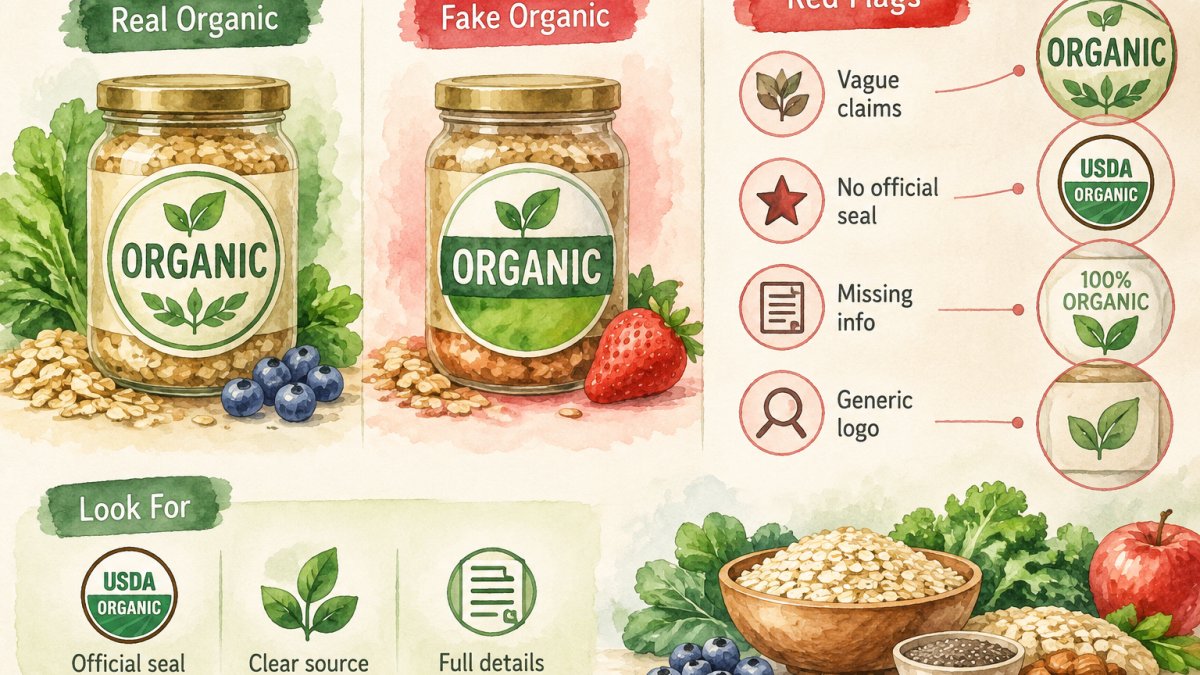
Watch out: a seal printed without a certifying agent name or code is not a valid USDA organic seal, no matter how official it looks. Real seals always name the body behind them.
Organic vs Natural Food Labels: One Is a Standard, One Is a Word
Organic vs natural food labels come down to this: “organic” is a legally defined standard with inspections, and “natural” is a marketing word with no certification behind it. One can be checked. The other cannot.
That gap is where fake organic labels thrive. A product labeled “natural” borrows the calm green feeling of organic without making any claim you can verify.
A common mistake is treating “natural” as a weaker version of organic. It is not a version of organic at all. It is a separate, largely unregulated term.
For a deeper breakdown of how these claims differ from non-GMO and other label types, see our guide to organic vs non-GMO pantry items.
Watch out: if a package leans on “natural,” “farm fresh,” or “made with real ingredients” but never names a certifying agent, treat the organic implication as unproven until you check.
How to Verify Organic Certification in Four Steps
You can verify organic certification in four steps: find the seal, read the certifying agent, search the official database, and confirm the product matches. The whole check takes a few minutes, and this is where most guides stop short, so here is what each step actually returns.
- Find the seal and read it closely. Look for the USDA organic seal plus the name of the certifying agent. A seal with no agent name is a red flag. Note whether the seal is the color version (allowed) or a black-and-white version (also allowed), both are legitimate; what matters is the agent name and code.
- Note the certifying agent code. This code identifies the accredited body that inspected the operation. It usually appears on the back panel near the seal, sometimes as a short alphanumeric string.
- Search the Organic Integrity Database. The USDA Organic Integrity Database lets you look up certified operations by name, state, or product. When you search, you are looking for a status of “certified”, not “suspended,” “surrendered,” or “pending.” A suspended operation is a major red flag even if the package still carries the seal.
- Confirm the product and handler match. The operation on the package should appear as certified for the product category you are holding. A farm certified for produce is not automatically certified for processed snacks.
Here is the gap most articles miss: the database is US-centric, so international imports need a different check. A product from the EU may carry the Euroleaf (the EU organic logo) rather than the USDA seal.
If any step fails, the seal is not doing its job. For a fuller walkthrough of each check, our step-by-step guide on how to verify organic certifications covers the paperwork side in detail.
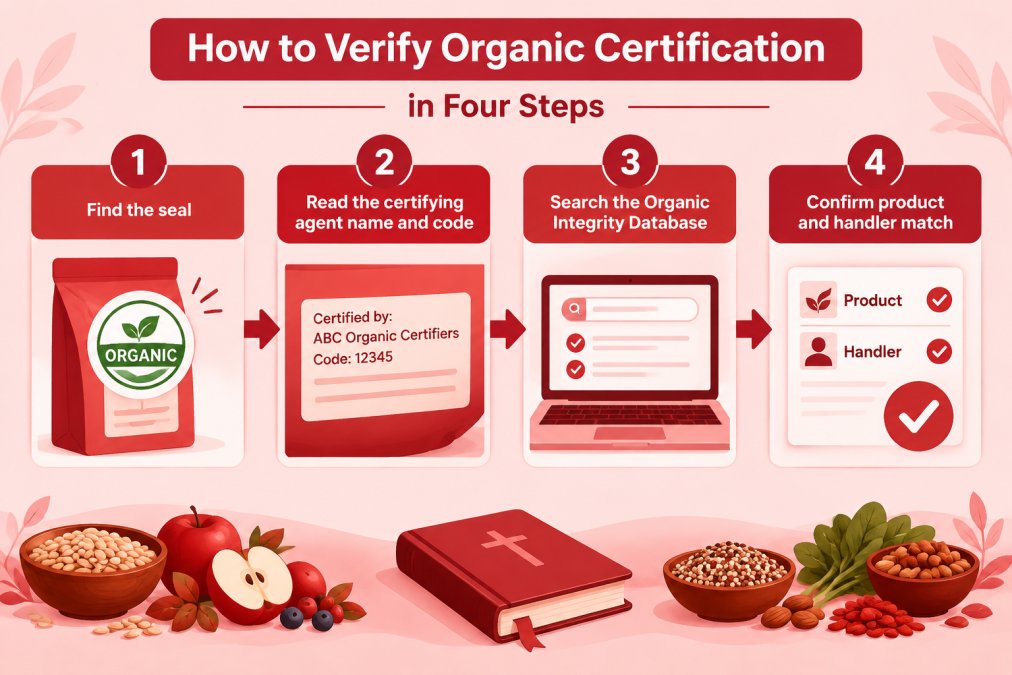
Here is the four-step check, and what each step actually returns.
| Step | What to do | What to look for |
|---|---|---|
| 1 | Find the seal and read it closely | USDA seal plus certifying agent name |
| 2 | Note the certifying agent code | Short alphanumeric string on back panel |
| 3 | Search the Organic Integrity Database | Status of certified, not suspended or surrendered |
| 4 | Confirm the product and handler match | Operation certified for that product category |
How to Check Organic Products Online Before You Buy
You can check organic products online by matching the listing to a certified operation before you add to cart. Online shopping hides the package, so the checks shift to the product page.
Look for these signals on any listing:
- A photo of the actual label, not just a logo graphic
- The certifying agent named in the product description
- A certifying agent code you can search
- Ingredient lists that match the organic claim
- A brand that answers certification questions directly
A listing that shows a green leaf icon but no certifying body is telling you something. Believe it.
When a product page is vague, ask the seller which agent certified the product and for the code. A legitimate seller answers quickly. A greenwasher changes the subject.
For a broader method, our guide on how to verify organic food quality walks through the online checks in order.
Marketing Buzzwords That Mean Nothing on a Label
Marketing buzzwords mean nothing on a label when no third-party standard sits behind them. “Eco-friendly,” “green,” “clean,” “pure,” and “farm fresh” are not certified claims. They are adjectives.
Here is the short list to ignore until proven otherwise:
- Eco-friendly and green. No defined standard, no inspection.
- Pesticide-free. Sounds strict, but it is not the same as certified organic.
- Clean label. A trend term, not a certification.
- Bio-certified. A real term in some countries, but meaningless on a US package with no named agent.
- Chemical-free. Everything is a chemical. This one is pure marketing.
The Federal Trade Commission green guides exist because green claims get abused. They set expectations for environmental marketing, and they are worth knowing when a label feels too good to be true.
Reading the Ingredient List for Hidden Additives
Reading the ingredient list catches what the front label hides. A product can carry an organic claim on one ingredient and still be mostly conventional filler.
Run these checks:
- Where does “organic” appear? If only one ingredient is starred organic, the product is not organic.
- How long is the list? Long lists on a “pure” product usually mean additives.
- Are there synthetic-sounding names? Some are allowed in processed organic foods, but many are not.
- Does the order match the claim? Ingredients are listed by weight. If the organic item is last, it is a trace amount.
A common mistake is trusting the front of the box and never turning it over. The back panel is where the truth lives.
Stocking a Trustworthy Organic Pantry at Allstarhealth
Stocking a trustworthy organic pantry starts with buying from sellers who show you the certification, not just the seal.
Here is how we would build the pantry:
-
Start with staples you use daily. Grains, oils, and superfoods carry the most volume in your diet.
-
Add wellness basics. Herbal medicine and essential oils round out a holistic pantry.
You can see a certified example in our Bono Organic Sicilian extra virgin olive oil, which carries a protected origin designation alongside its organic claim. If you are ready to rebuild your shelves, our guide on how to transition to organic pantry staples maps out the switch step by step.
Frequently Asked Questions
How can you tell if an organic label is genuine?
Start with the seal: a genuine USDA Organic label shows the round seal plus the name of the certifying agent, either on the front panel or in the ingredient statement. Then check the ingredient list to confirm the product is fully certified rather than ‘made with organic’ ingredients. Finally, look up the certifying agent and product in the USDA Organic Integrity Database. A real label survives all three checks; a fake organic label usually fails at the second or third.
Is the word organic on a package enough to prove certification?
No. The word alone does not prove anything, which is exactly how misleading products get onto shelves. A certified product carries the USDA seal and names its certifying agent, and its handler appears in the integrity database. If a package says organic but shows no seal, no certifier, and no database record, treat the claim as unverified. Check the product online before you add it to your pantry.
What is the difference between organic and made with organic?
A product labeled simply organic must meet the full USDA standard and can carry the seal. A product labeled ‘made with organic’ ingredients uses only some organic components and cannot display the seal. Both claims have rules behind them, but only the first means the whole product is certified. When you compare organic vs natural food labels, remember that ‘natural’ has no certification behind it at all.
Where can you report a misleading organic claim?
Report suspected fake organic labels to the USDA National Organic Program and to the certifying agent named on the package. Include photos of the label, the lot code, and where you bought it. You can also flag the listing to the retailer, since online sellers are responsible for what they advertise. Keeping the receipt and packaging makes the report far more useful to investigators.
Fake labels survive on the assumption that nobody checks. You now know the four checks that break that assumption. Allstarhealth makes the sourcing side easier, with a curated selection of natural and organic pantry staples, superfoods, and wellness resources, plus the certification details you need to verify each one. Get started with Allstarhealth and build a pantry you can actually trust.