Last Updated: November 5, 2026
Quick Summary
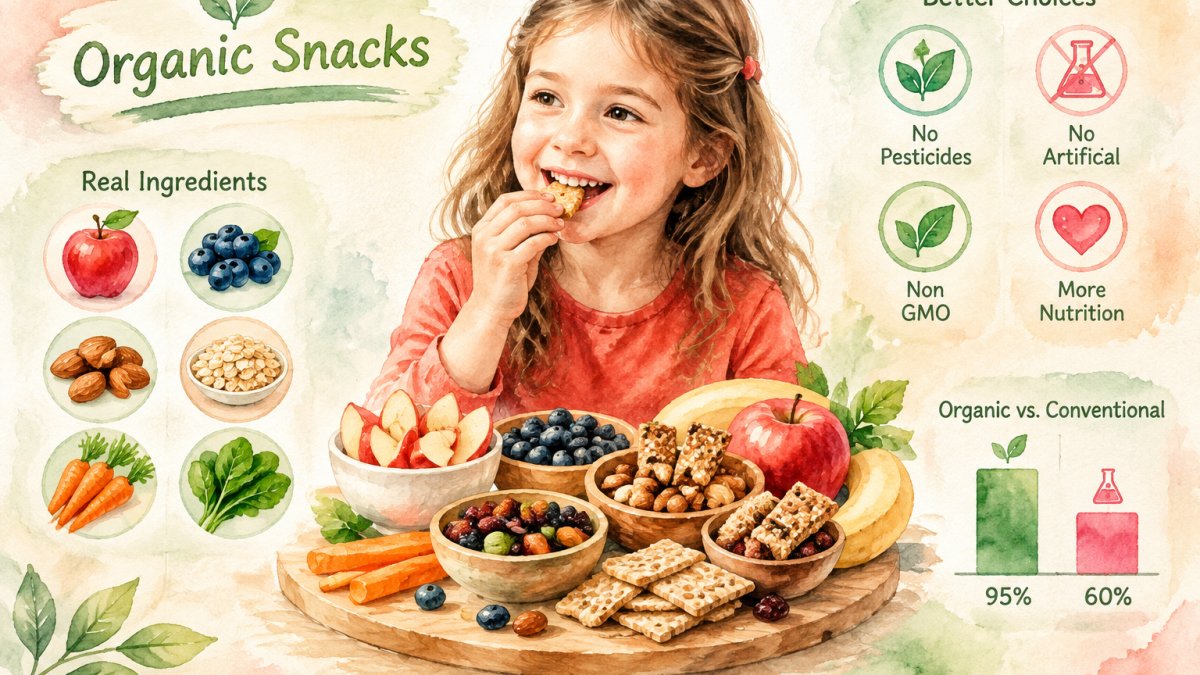
Choosing healthy organic snacks for kids means picking foods grown without synthetic pesticides, made without unnecessary additives, and balanced across food groups. Start with the USDA organic seal and a named certifier, then read the first three ingredients and check that two food groups appear. Organic snacks are a farming and processing claim, not a health claim, so the label alone never guarantees nutrition.
- The organic seal verifies how food was grown, not how nutritious it is.
- Made with organic means at least 70 percent organic ingredients and no seal.
- Use five checks: seal, ingredient list, food groups, safety, cost per serving.
- Quarter grapes lengthwise, not crosswise, and skip popcorn under age four.
- Buy dried fruit, oats, and seeds in larger packs and portion them at home.
Table of Contents
- Why Organic Snacks for Kids Are Worth the Extra Care
- What to Look for When Choosing Organic Snacks for Kids
- Healthy Kid Snacks for School That Survive the Lunchbox
- Healthy Kid Snacks Homemade: Simple Recipes and Batch Ideas
- Healthy Kid Snacks to Buy: Store-Bought Choices That Earn Their Place
- Age-Appropriate Safety and Allergy-Aware Choices
- Building a Budget-Conscious Organic Snack Pantry
- Stocking Your Pantry with Allstarhealth
- Frequently Asked Questions
Why Organic Snacks for Kids Are Worth the Extra Care
Choosing healthy organic snacks for kids is the practice of picking foods that are grown without synthetic pesticides, made without unnecessary additives, and balanced across food groups. Snack time is a small daily decision that adds up over years.
That framing matters. A snack is not a treat between meals. For most children it is a third or fourth eating moment of the day, and it quietly shapes what they expect food to taste like.
Proverbs 16:24 says, “Gracious words are a honeycomb, sweet to the soul and healing to the bones.” Sweetness, in other words, can be a good thing. The question is where it comes from.
What makes organic worth the effort:
- Fewer synthetic pesticide residues on the fruit and vegetables your child eats most
- Stricter rules on additives and processing aids
- A shorter, easier-to-read ingredient list
- Usually more whole food, less reconstruction
The USDA National Organic Program sets the standards behind that “organic” seal. Knowing what the seal does and does not cover is the first real skill.
Below, we walk through how to read labels, build a repeatable picking system, and stock a pantry that works on a real budget.
What to Look for When Choosing Organic Snacks for Kids
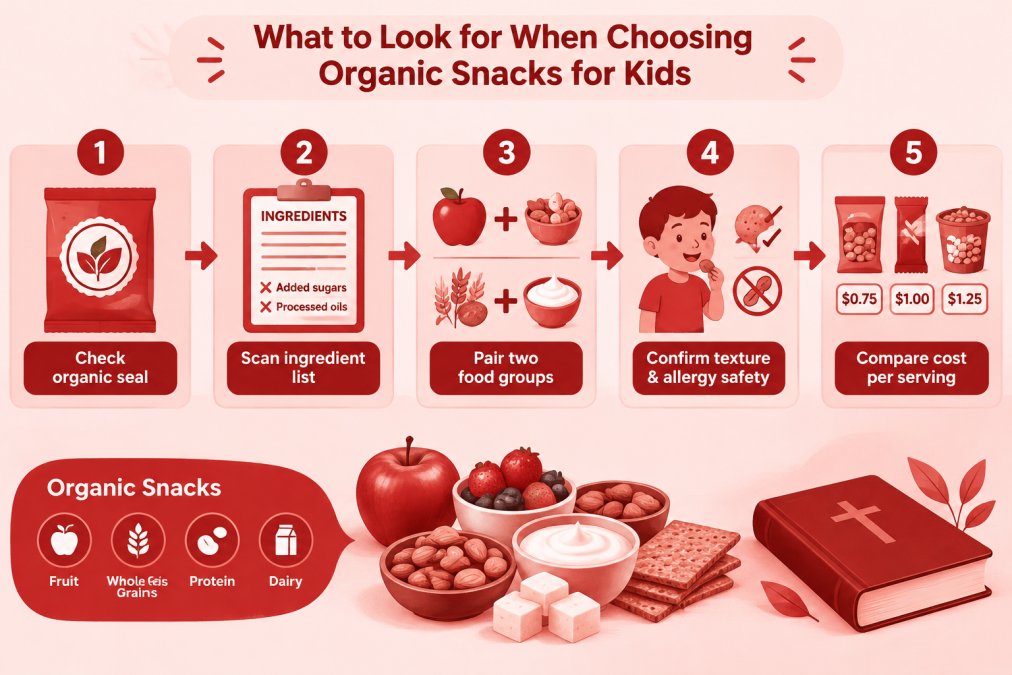
Start with the seal, then read the ingredient list, then check the food groups. A snack that passes all three is a snack you can buy on repeat without thinking about it.
Most parents stop at the seal. That is the mistake. The organic seal tells you how something was grown. It says nothing about whether the product is mostly sugar.
Reading the Organic Label Without Getting Fooled
The USDA National Organic Program sets the standards behind the seal, and knowing what those standards do and do not cover is the first real skill. Certification verifies how crops are grown and how processed foods are handled: no synthetic pesticides on the prohibited list, no genetically engineered ingredients, no sewage sludge or irradiation, and a defined list of allowed non-synthetic and limited synthetic substances.
Three label traps to know:
- “Made with organic” means at least 70 percent of ingredients by weight are certified organic, and the product cannot carry the seal
- “100% organic” means every ingredient except water and salt is certified organic and the seal is allowed
- “Natural” has no legal definition for most foods and means little
- “No added sugar” can still mean high natural sugar or non-caloric sweeteners
To identify a genuinely certified product, look for the USDA organic seal on the front panel and the certifier’s name on the back or side. The certifier’s name is your traceability link if you want to verify a claim. If a package says “organic” but carries no seal and no certifier, treat the claim as marketing.
Comparing ingredient lists is where organic and nutritious diverge. Two organic snacks can differ wildly. Read the first three ingredients, because they are listed by weight. If the first two are a sweetener and a starch, put it back regardless of the seal.
A Repeatable Snack-Selection Framework for Busy Parents
Use the same five checks every time and decisions get faster.
| Step | Check | What Good Looks Like |
|---|---|---|
| 1 | Organic seal | Seal present with a named certifier, not just “made with organic” |
| 2 | Ingredient list | Five items or fewer, recognizable, no sweetener in the first two |
| 3 | Food groups | Two groups represented, such as fruit plus protein or whole grain plus dairy |
| 4 | Safety | Texture and allergens suit your child’s age |
| 5 | Cost per serving | Fits your weekly snack budget |
Run this on your ten most-bought snacks once. You will not need to re-run it often.
Watch out: a product can pass the seal check and still fail the ingredient check. The framework is ordered so the cheap visual checks come first and the label reading comes second, do not skip step two because step one passed.
Healthy Kid Snacks for School That Survive the Lunchbox
The best school snacks are the ones that come home eaten, not squashed. That means sturdy textures, no refrigeration, and packaging a child can open alone.
Here is what holds up in a lunchbox:
- Dried Turkish figs, which travel well and need no prep
- Whole grain crackers with a sealed cheese stick
- Freeze-dried fruit, which stays crunchy and does not leak
- Seaweed or nori sheets, light and salty
- Unsweetened applesauce pouches with a nut-free seed butter
Skip anything that needs a spoon, a fridge, or adult hands.
For a ready-to-buy option that survives the bag, our organic fig snack packs are built for exactly this job.
Healthy Kid Snacks Homemade: Simple Recipes and Batch Ideas
Homemade wins on cost and control. It loses on time. So batch, freeze, and repeat.
Four ideas that hold up well:
- Oat and seed bites. Rolled oats, seed butter, honey, a little cinnamon. Roll into balls, chill, store a week.
- Roasted chickpeas. Drain, toss in olive oil and paprika, roast until crunchy. Keeps three days in a sealed jar.
- Yogurt bark. Spread plain yogurt on a tray, scatter berries, freeze, break into shards.
- Veggie sticks with hummus. Cut carrots and peppers on Sunday, portion into containers.
Watch out: homemade snacks without preservatives spoil faster. Label containers with the day you made them and toss anything past its window.
Healthy Kid Snacks to Buy: Store-Bought Choices That Earn Their Place
Store-bought snacks earn their place when they are genuinely convenient and genuinely decent. Some do. Most do not.
What we look for on a shelf:
- An organic seal on the front
- No added sugar in the first three ingredients
- A protein or fat source, not just carbohydrate
- Single-serve packaging that actually reseals
Our organic dried fruit variety pack covers mango, papaya, pineapple, banana, and jackfruit in one box, which solves the “they only like one kind” problem.
If you want to compare delivery options before ordering, our guide to the best organic pantry delivery sites covers what to check.
Age-Appropriate Safety and Allergy-Aware Choices
Texture is a safety issue, not a preference. Whole nuts, whole grapes, and hard raw carrot rounds can be choking risks for younger children. The fix is mechanical: change the shape and the firmness before the food reaches the plate.
Age guidance in practice:
- Under three: soft, mashable textures; no whole nuts, no round foods, no hard raw vegetables. Quarter grapes lengthwise, grate raw carrot, and spread nut butter thin rather than in a glob.
- Three to five: small pieces, quartered grapes, thin spreads, and cooked vegetables cut into short strips rather than coins.
- School age: most textures fine, but still supervise large hard items and avoid whole nuts until you are confident in your child’s chewing.
Preparation mechanics that matter more than the age label:
- Grapes and cherry tomatoes: quarter lengthwise, not crosswise. A crosswise coin is still round.
- Nuts and seeds: use butter, paste, or finely ground meal for younger children; whole nuts wait.
- Raw carrot and apple: grate, julienne, or cook until a fork pierces them easily.
- Popcorn: skip under four; it is a common choking culprit.
- Sticky foods: halve or thin dried fruit and avoid large spoonfuls of nut butter, which can lodge.
Allergies need the same care. Read the full label every time, because recipes change without notice and “may contain” statements shift between batches. Introduce common allergens one at a time at home, not at school, so a reaction is easy to spot and easy to describe. Keep a written record of what was introduced and when.
Dietary substitutions should replace, not remove. A dairy-free child still needs a protein and a fat at snack time, so pair fruit with seed butter or a fortified plant-based yogurt rather than dropping the dairy and leaving only carbohydrate. A gluten-free child needs whole-grain alternatives such as certified gluten-free oats or buckwheat, not just refined starches.
Watch out: “allergy-friendly” and “organic” are independent claims. An organic snack can still contain a common allergen, and an allergen-free snack can still be highly processed. Check both labels separately.
Building a Budget-Conscious Organic Snack Pantry
Organic and budget-friendly can coexist. They just need a plan.
What works:
- Buy dried fruit, oats, and seeds in larger packs and portion at home
- Build snacks around two or three cheap staples
- Keep a running list so you buy the same ten things
- Compare cost per serving, not pack price
What does not work is buying whatever looks healthy in the moment. That is how pantries fill with half-eaten bags.
For a fuller plan on stocking up without overspending, our guide on how to build a healthy pantry on a budget walks through it step by step.
Stocking Your Pantry with Allstarhealth
Allstarhealth is an online shop for natural and organic pantry staples, from grains and superfoods to wellness essentials.
What you will find:
- A curated organic food range
- Ancient and Biblical recipe inspiration alongside the products
- Herbal medicine and essential oils for the wellness side of the pantry
If you are ready to start stocking, you can shop natural foods and pantry essentials and build the snack shelf from there.
Frequently Asked Questions
What should parents look for when choosing organic snacks for kids?
Start with a certified organic label, then read the ingredient list. Look for short lists built from whole foods: fresh fruit, raw vegetables, whole grains, dairy, nuts or seeds. Check the nutrition label for added sugars and fiber. Aim for a balanced snack that pairs two food groups, such as apple slices with cheese sticks or hummus with whole-grain crackers. Finally, match texture and portion size to your child’s age.
Are organic snacks always healthier for children?
No. Organic refers to how ingredients are grown and processed, not to nutritional quality. An organic fruit snack or organic cookie can still carry added sugars and little fiber. Compare the ingredient list and nutrition label the same way you would for conventional products. A conventional apple beats an organic gummy every time. Use the organic label as one filter, then judge the whole food.
What are some healthy organic snacks kids can take to school?
Choose shelf-stable, easy-open options: seaweed or nori packs, freeze-dried fruit, whole-grain crackers with single-serve hummus, cheese sticks, yogurt tubes, and homemade trail mix with seeds and dried fruit. Check your school’s allergy policy before packing nuts. For homemade options, baked oat bars and vegetable muffins hold up well in a lunchbox. Keep portions small and pair a carbohydrate with a protein or healthy fat.
How can I keep organic snacks affordable for a busy household?
Focus organic spending on items where it matters most to you, such as fresh fruit, vegetables, dairy and grains, and buy those in bulk when possible. Build homemade snacks from bulk oats, seeds and dried fruit, which usually cost less per serving than packaged alternatives. Plan a weekly snack rotation, compare unit prices, and use store loyalty programs. Buying larger formats and repacking into small containers saves money and waste.
The challenge is not knowing that organic snacks are better. It is building a shelf that actually stays stocked, stays affordable, and gets eaten. That is the problem we built Allstarhealth to solve, with a curated organic range, Biblical recipe guidance, and herbal and natural wellness products in one place. Get started with Allstarhealth and build a snack pantry your kids will actually finish.