
Last Updated: November 21, 2026
Quick Summary
You build a bulk food pantry on a budget by starting with one shelf and a small weekly amount you can repeat for six months, buying extras of what you already cook before adding new staples. Repackage dry goods into airtight containers on shopping day, rotate first-in first-out, and compare unit prices before any large purchase.
- Scale starter quantities to household size: a two-person home needs roughly half of what a four-person home needs.
- White rice and dried beans store about 24 months, while flour keeps only 6 to 12 months.
- Repackaging dry goods on the day you shop is the most effective defense against pantry moths and weevils.
- Buy no more of a staple than the household will finish within its realistic shelf life.
- Spread bulk purchases across pay cycles, choosing one bulk item per trip instead of five at once.
Table of Contents
- What Is a Bulk Food Pantry and Why Does It Matter?
- A Biblical Case for Storing Food Wisely
- How to Build a Pantry Gradually Without Overspending
- Your Bulk Pantry Staples List for a Beginner
- How to Store Bulk Grains and Keep Them Fresh
- Bulk Buying Without Waste or Cash-Flow Strain
- Cheap Meals With Pantry Staples Your Family Will Eat
- Stocking Your Pantry With Allstarhealth
- Frequently Asked Questions
What Is a Bulk Food Pantry and Why Does It Matter?
A bulk food pantry is a stored supply of shelf-stable staples, bought in larger quantities than a single week’s shopping, that you draw from for everyday meals.
Proverbs 16:24 says, “Gracious words are a honeycomb, sweet to the soul and healing to the bones.” A well-kept pantry works a little like that honeycomb: steady, sweet, and ready when the day turns hard. You are not hoarding. You are preparing.
The mistake most people make is buying a mountain of food in one go, then watching half of it spoil. Building gradually, with a list and a budget, is the whole game.
A Biblical Case for Storing Food Wisely
Scripture treats careful storage as wisdom, not fear. Joseph stored grain through the years of plenty so Egypt could eat through the lean years. Proverbs points the reader toward the ant, which gathers food in summer.
That last part matters. A pantry is not a locked vault. It is a tool for hospitality and for calm.
If you want the fuller picture of what a biblical pantry looks like in practice, our guide on how to build a biblical pantry walks through the whole framework, from first principles to the first shopping trip.
How to Build a Pantry Gradually Without Overspending
Start with one shelf, not one room. The gradual method spreads the cost across weeks and lets you learn what your household actually eats before you commit to a sack of anything.
Here is the approach we recommend:
- Week 1: Set a weekly pantry amount you can repeat without stress.
- Weeks 2-4: Buy only extras of what you already cook.
- Month 2: Add one new staple per shopping trip.
- Month 3: Review what sat untouched and stop buying it.
- Month 6: You have a working pantry without a single painful bill.
The pantry grows in the background of normal life. That is the point.
Setting a Realistic Starting Budget
A realistic starting budget is one you can spend every single week for six months, not a heroic amount you spend once. Pick a figure small enough that a surprise repair bill does not wreck it. A modest, steady weekly amount can build the habit as it builds the shelf.
Track what you spend in a simple notebook or phone note. After a month, you will know your true pace. Adjust once, then leave it alone.
Your Bulk Pantry Staples List for a Beginner
The best bulk pantry staples list is short, cheap, and built around meals you already cook. Dry goods first, then canned goods, then flavor boosters. Skip anything you cannot picture using in a normal week.
A beginner’s list looks like this:
- Rolled oats and rice
- Dried beans and lentils
- Pasta and flour
- Canned tomatoes and canned beans
- Cooking oil, salt, and spices
- Peanut butter or another cheap protein
That is a working pantry. Everything else is expansion.
A Complete Starter Inventory With Quantities
Scale quantities to household size, not to ambition. A two-person home needs roughly half of what a four-person home needs, and a smaller starter inventory is easier to rotate before anything ages.
| Staple | 2-Person Household | 4-Person Household | Approx. Shelf Life |
|---|---|---|---|
| Rolled oats | 2 kg | 4 kg | 12 months |
| White rice | 5 kg | 10 kg | 24 months |
| Dried beans | 2 kg | 4 kg | 24 months |
| Pasta | 3 kg | 6 kg | 24 months |
| Flour | 3 kg | 6 kg | 6-12 months |
| Canned tomatoes | 12 cans | 24 cans | 18 months |
Approx. Shelf Life
Store the smallest amounts first. Add a second row of each staple only once the first is half gone.
For a wider spread of natural foods beyond grains and beans, our breakdown of how to build a healthy pantry with natural foods covers the full range of whole grains, nuts, seeds, herbs, and everyday essentials.
How to Store Bulk Grains and Keep Them Fresh
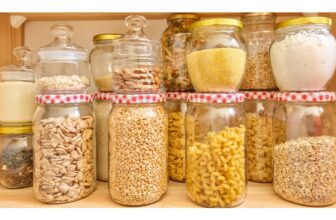
Knowing how to store bulk grains is the difference between a pantry and a waste bin. The enemies are moisture, heat, light, and pests, and each one has a specific countermeasure. Beat all four and your grains will outlast their labels.
The conditions that matter
Dry goods generally keep best in a cool, dark, dry space with steady temperature. A pantry away from the oven, the water heater, and direct sun is ideal. Fluctuating heat is worse than a consistently cool spot, because condensation forms inside containers when temperatures swing.
Light degrades oils in whole grains and nuts, which is why opaque or dark containers outperform clear ones for anything with a higher fat content. Pests, pantry moths and weevils especially, arrive in the product itself or through gaps in packaging, so repackaging on the day you shop is the single most effective defense.
Containers and repackaging
Use airtight containers, not the bag they came in. Bags tear, do not reseal reliably, and offer no barrier to pests.
For larger volumes, a two-layer approach works well: a food-grade bucket or large airtight bin for the bulk supply, and smaller jars or containers for the working portion you open day to day.
Watch out: do not top off an old container with new grain. Mixing dates makes rotation impossible and can carry older product forward indefinitely. Finish or empty the old container first, then refill.
Shelf life and rotation
Not all grains are equally patient. White rice and dried beans store well for a long time under good conditions. Flour and whole grains turn rancid faster because of their natural oils, so buy those in smaller amounts and rotate them first.
Rotation is the habit that makes shelf life real. Use the first-in, first-out rule: new purchases go behind or below older ones, and the oldest is always the next opened. A simple date label on every container makes this automatic.
For deeper guidance on keeping grains good for the long haul, read our article on how to store organic grains long term. And if you want containers ready to go, the Vtopmart airtight flour and sugar storage set comes in multiple sizes with a proper seal.
Bulk Buying Without Waste or Cash-Flow Strain
Bulk buying saves money only when three things line up: the unit price is genuinely lower, the food gets eaten before it spoils, and the upfront cost does not crowd out the rest of the grocery budget. Most advice stops at “buy in bulk.” The useful part is the math and the capacity check that come before the purchase.
Run the unit-price comparison before you commit
Package price tells you almost nothing. Unit price, cost per ounce, per pound, or per serving, is the only number that answers whether bulk is cheaper.
Warehouse clubs can be cheaper on some high-volume staples and more expensive on others once membership and travel are counted. The same bag of oats can be cheaper per pound at a regular grocery store during a sale than at a warehouse on a normal day.
Two adjustments matter. First, compare like with like, instant oats against instant oats, not against rolled oats. Second, factor in what you will realistically use.
Check storage capacity and spoilage risk first
Before any large purchase, walk the shelf. Ask three questions: Where will this go, in what container, and how fast will we eat it? If the answer to any of those is vague, the bulk buy is a gamble.
A practical rule is to buy no more of a staple than the household will finish within its realistic shelf life, allowing a margin for rotation.
Storage capacity is a real constraint, not a formality. Airtight containers take up more room than the bags they replace, and a pantry crammed past its capacity is a pantry where things get lost and forgotten. Measure the shelf before you measure the savings.
Protect cash flow with a rhythm, not a haul
Cash-flow strain is the quiet reason many bulk pantries stall. A dramatic haul feels productive, but it can leave the household short for the rest of the month and make the next normal shop harder.
A steadier approach is to spread bulk purchases across pay cycles: one bulk item per trip, chosen from the running unit-price note, rather than five at once. This keeps the weekly budget intact while the pantry grows in the background. It also gives you time to learn what the household actually eats before committing to a larger quantity of anything.
A bargain you cannot store, rotate, or finish is not a saving.
Cheap Meals With Pantry Staples Your Family Will Eat
Cheap meals with pantry staples work when you cook from scratch and lean on flavor boosters. Beans and rice, oat porridge, pasta with canned tomatoes, lentil soup, and simple flatbreads cover most of the week.
The trick is seasoning. Onions, garlic, cumin, smoked paprika, and a good stock cube turn plain staples into food people ask for again. Build a small spice shelf and your cheap meals stop tasting cheap.
A whole-grain cookbook earns its place here. The Simply Ancient Grains cookbook gives practical recipes for turning bulk grains into real meals rather than side dishes nobody finishes.
Stocking Your Pantry With Allstarhealth
A pantry built on cheap staples is a good start. A pantry built on good staples is better. That is where we come in.
Allstarhealth offers a curated selection of natural and organic pantry staples and superfoods, along with herbal medicine, essential oils, and ancient and biblical recipes.
You do not need a big budget to start. You need a list, a steady rhythm, and staples worth keeping.
Building a bulk food pantry on a budget is a slow, unglamorous, deeply worthwhile project. Start with one shelf this week, add one staple per trip, and let six months do the rest.
Frequently Asked Questions
How do you start a bulk food pantry on a budget?
Start with a written list of the meals your household already eats, then buy only the staples those meals require. Set aside a small fixed amount from each grocery trip and add one or two items at a time. Buy shelf-stable basics such as rice, oats, beans, pasta, and canned goods when they are on sale, and compare unit prices rather than package prices. A bulk food pantry grows through consistent small purchases, not one large shop.
Which bulk pantry staples should you buy first?
Begin with the items you cook with weekly: rice, oats, dried or canned beans, pasta, flour, and a few canned vegetables and tomatoes. Add cooking oil, salt, and the spices your family actually uses. Once those are steady, expand into lentils, barley, and other grains. Prioritizing foods the household already eats prevents waste and keeps your starter inventory useful rather than decorative.
How should you store bulk grains to keep them fresh?
Transfer grains from bags into airtight containers and label each with the date you opened it. Keep containers in a cool, dark, dry place away from the stove and direct sunlight. Whole grains spoil faster than refined ones, so buy smaller amounts of those and rotate older stock to the front. Repackaging into portioned containers also makes it easier to spot pests or moisture early.
What are inexpensive meals you can make from pantry staples?
Beans and rice, oat porridge with cinnamon, pasta with canned tomatoes and garlic, lentil soup, and simple flatbread from flour and water all rely on shelf-stable basics. Add a protein and a flavor booster such as onions, cumin, or smoked paprika to keep them satisfying. Planning a week of pantry meals around your starter inventory shows you what to restock and keeps the grocery budget predictable.